Edo Kiriko · Story
What Is Edo Kiriko? Japan's Cut Glass Craft, Explained
By Yuki Watanabe · Updated August 22, 2026
Edo Kiriko (江戸切子) is a traditional Japanese cut-glass craft that began in Tokyo in 1834, when a glassworker named Kagaya Kyubei first engraved patterns into glass using emery powder. Artisans cut precise geometric patterns — each with its own meaning — through a thin layer of colored glass, revealing the clear crystal beneath. The Japanese government designated it a national traditional craft in 2002, and today the finest pieces are used by the Imperial Household and served in Japan’s best bars.
I’m a designer living in Japan, and Edo Kiriko is the first craft I chose to write about on this site — because nothing else I know puts pattern, the thing I work with every day, so literally into your hand.
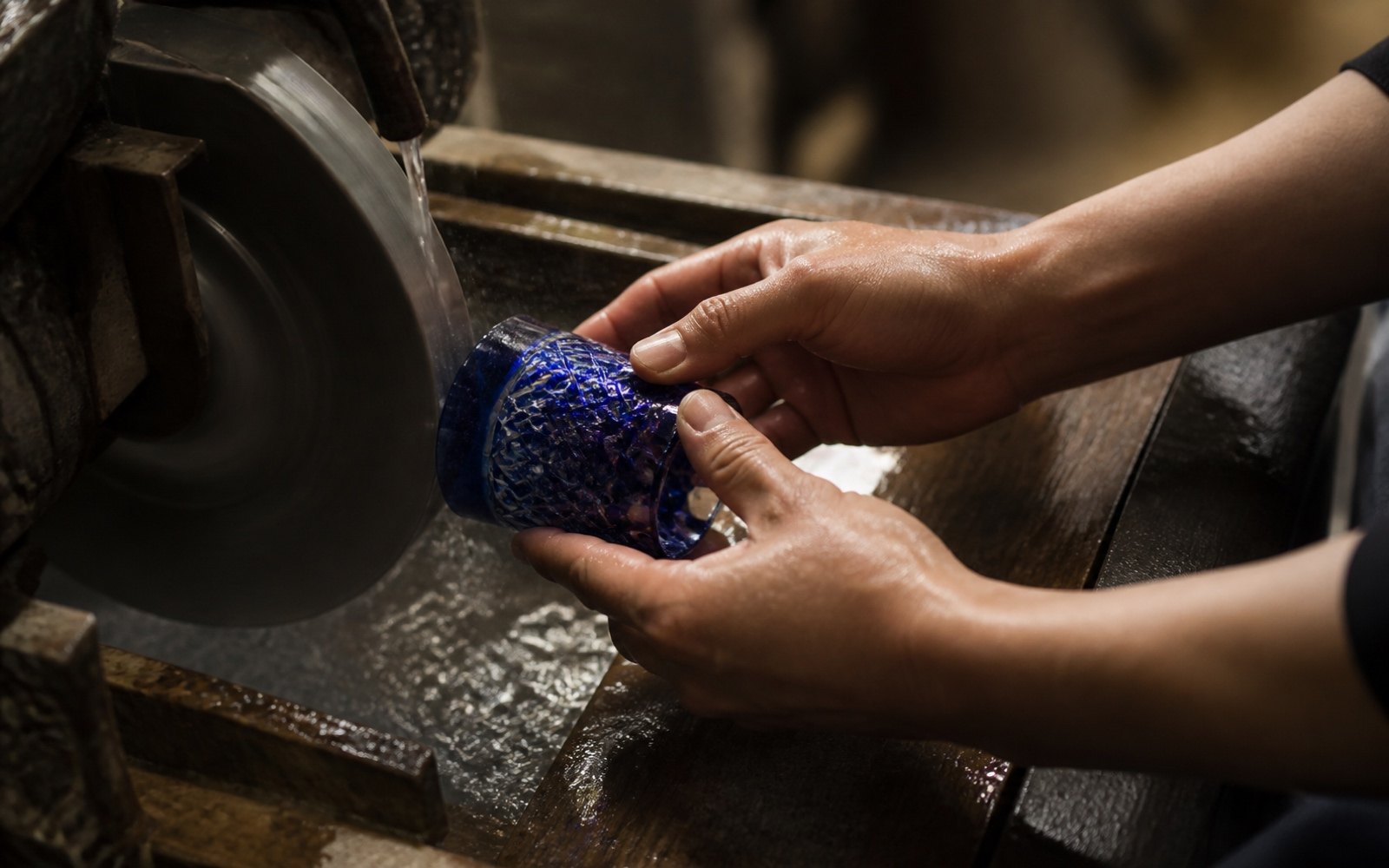
Note: photographs on this page are illustrative images of the craft. Product photos in each card come from the shop’s own listing.
A short history: from Edo merchants to the Imperial table
Edo Kiriko was born in the final decades of the Edo period. In 1834, Kagaya Kyubei, who ran a glass shop in Odenmacho, near today’s Nihonbashi in Tokyo, began cutting decorative facets into glass surfaces with emery sand. The technique spread through the city’s merchant culture — glassware for sake, for sweets, for showing off a little.
The craft took its modern form in the Meiji era. In 1881, the government invited the English cut-glass engineer Emanuel Hauptmann to train Japanese craftsmen in European techniques. That meeting — Edo playfulness, British precision — is essentially the Edo Kiriko you see today.
Two dates matter for authenticity. In 1985, Tokyo designated Edo Kiriko a traditional craft of the metropolis; in 2002, Japan’s Ministry of Economy, Trade and Industry (METI) designated it a Traditional Craft of Japan — a legal definition, not a marketing phrase. And in 1934, Kagami Crystal was founded as Japan’s first factory dedicated to crystal glass; it went on to supply the Imperial Household and Japanese embassies around the world, and remains the name most collectors start with.
The patterns, and what they mean
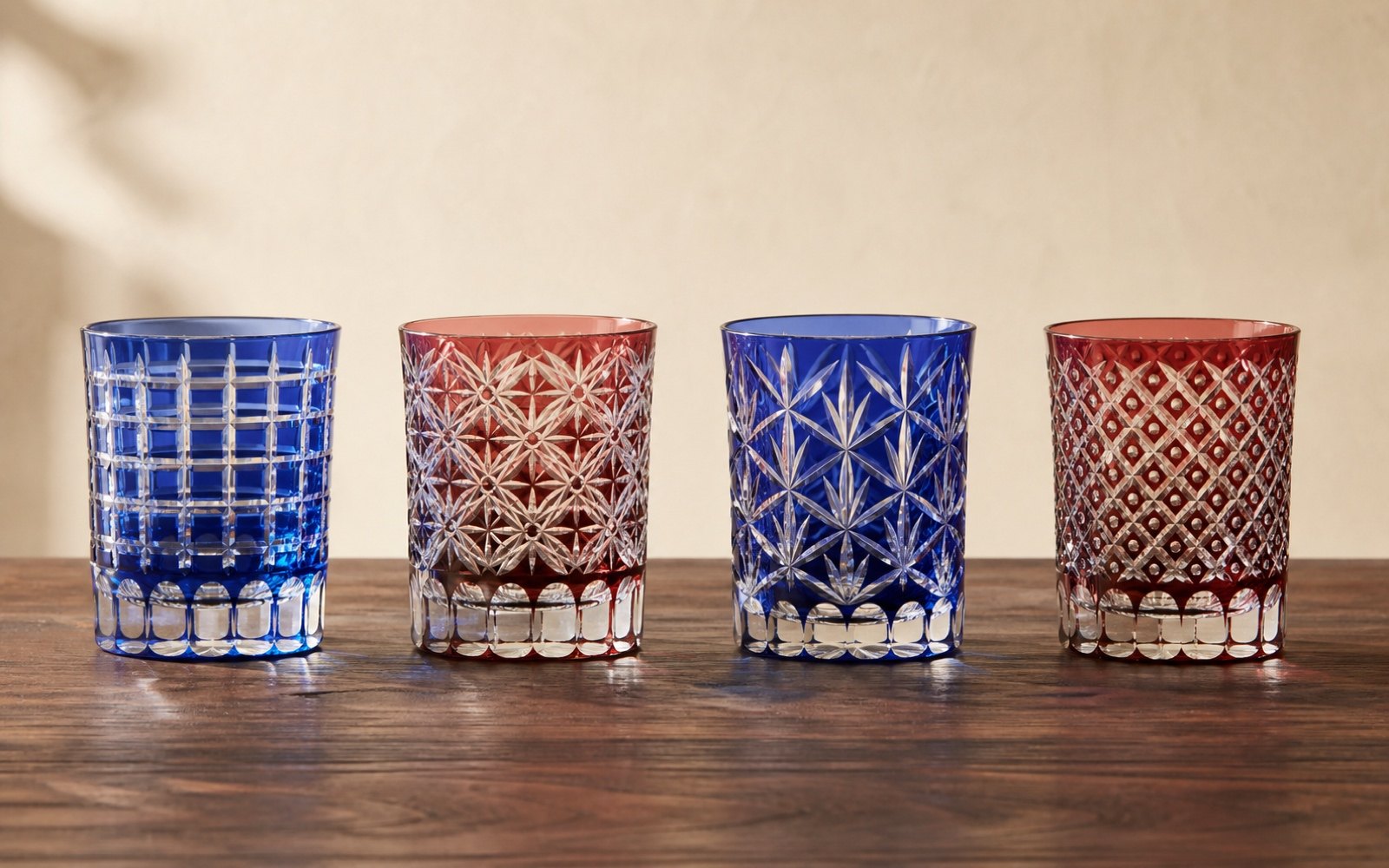
The quickest way to fall for Edo Kiriko is to learn what you are looking at. These are the classic monyō (文様) — traditional patterns — you will meet again and again:
| Pattern | Japanese | Meaning |
|---|---|---|
| Yarai | 矢来 | Bamboo fence — protection from evil |
| Kiku-tsunagi | 菊繋ぎ | Chained chrysanthemums — longevity |
| Asa-no-ha | 麻の葉 | Hemp leaf — healthy growth (hemp grows fast and straight) |
| Nanako | 魚子 | Fish roe — prosperity and abundance |
| Kikka | 菊花 | Chrysanthemum bloom — nobility, the Imperial flower |
This is why Edo Kiriko works so well as a gift in Japanese culture: the pattern is the message. A chrysanthemum-cut glass given to a parent quietly says “live long.” A hemp-leaf pattern is a classic gift for someone starting something new.
How a single glass is made
An Edo Kiriko glass is made backwards, in a sense — the color comes first and is then cut away. The process, condensed:
- Kise-glass (被せガラス) — a thin layer of colored glass is fused over clear crystal. The thinner and more even this layer, the sharper the final contrast.
- Wari-dashi (割り出し) — the only “drawing” stage: reference lines are marked on the glass in ink. There is no stencil. The pattern lives in the craftsman’s hands.
- Arazuri (粗摺り) — the rough cut, grinding the main pattern through the color layer with a diamond wheel.
- Sanban-gake (三番掛け) — finer wheels refine each facet.
- Ishi-kake and migaki (石掛け・磨き) — polishing with stone wheels, then restoring full transparency to every cut, traditionally with wood and cerium.
A craftsman capable of first-class work has typically spent about ten years reaching that level. When you tilt a good glass under light and every facet flashes evenly — that evenness is the ten years.
Edo Kiriko vs. Satsuma Kiriko
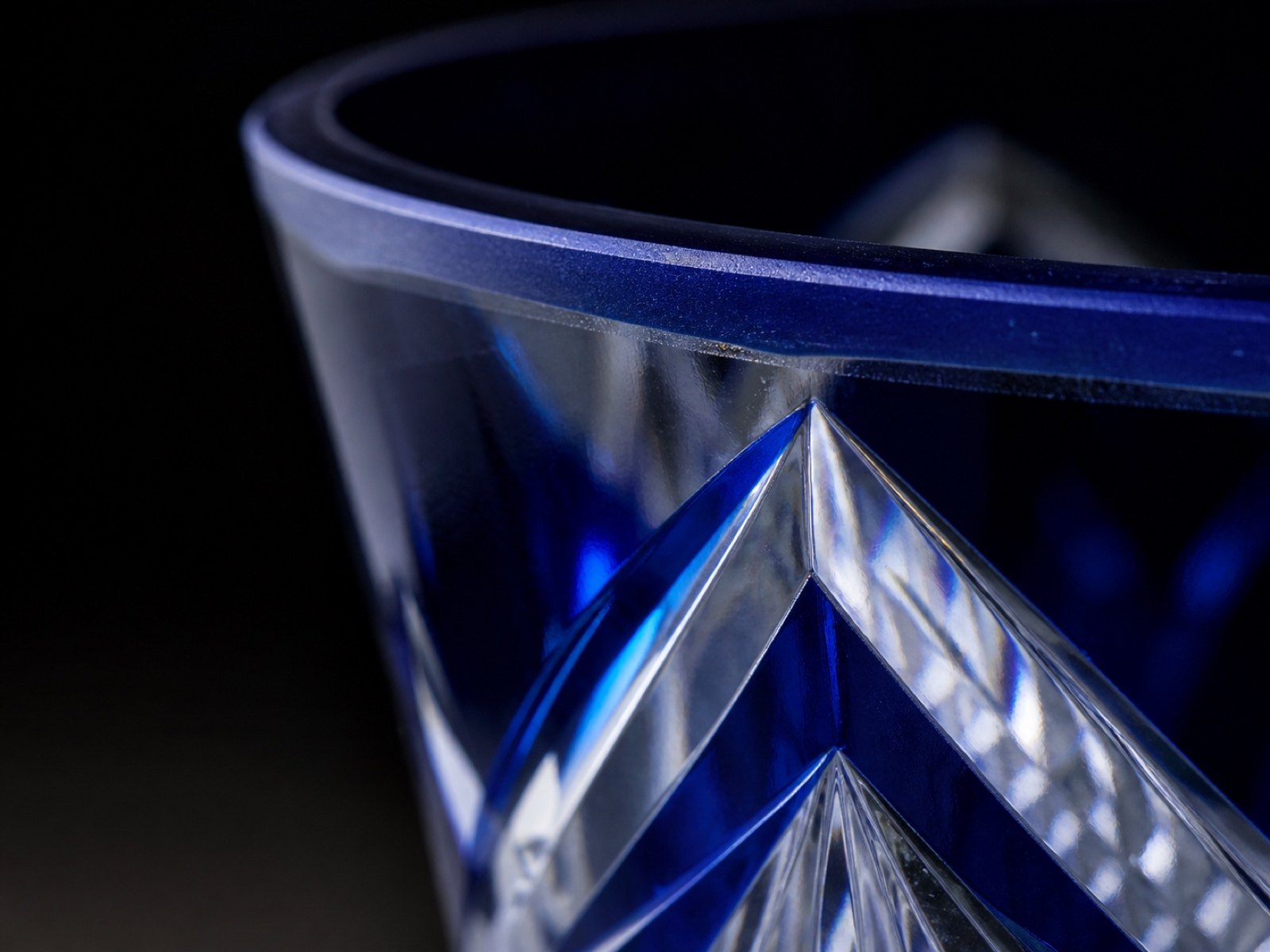
People often confuse Japan’s two great cut-glass traditions. They are easy to tell apart once you know the one key difference: the thickness of the colored layer.
| Edo Kiriko (Tokyo) | Satsuma Kiriko (Kagoshima) | |
|---|---|---|
| Colored layer | Thin | Thick |
| Look of the cuts | Sharp, high-contrast | Soft gradation (“bokashi”) |
| History | Continuous since 1834 | Died out ~1870s, revived 1980s |
| Typical price | High | Very high (smaller production) |
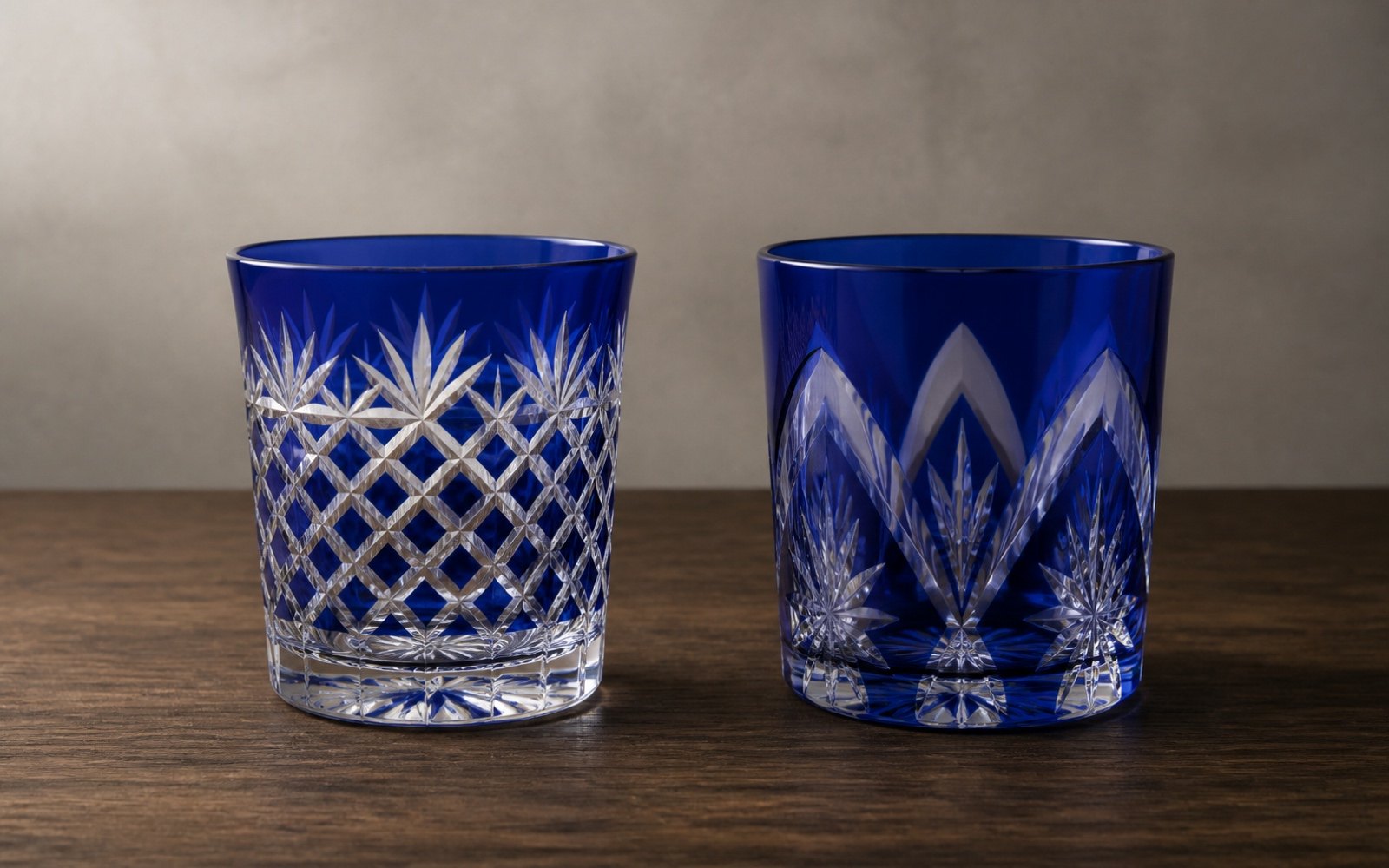
Neither is “better.” Edo Kiriko reads as crisp and rhythmical; Satsuma Kiriko as misty and romantic. As a designer I reach for Edo Kiriko when I want a glass that behaves like a pattern, and Satsuma when I want one that behaves like a watercolor.
How to spot an authentic piece
Four things I check, in order:
- The cuts meet cleanly. Follow any line to an intersection. On authentic work the crossing is exact; on machine-pressed imitations the “cuts” are molded, rounded, and slightly misaligned.
- Weight and ring. Crystal glass is noticeably heavier than soda glass, and taps with a longer, clearer ring.
- The maker. Kagami Crystal, Hirota Glass, Kimoto Glass and the certified studios of the Edo Kiriko Cooperative are the established names. A certified piece carries the cooperative’s sticker or an engraved mark.
- The box. Fine Edo Kiriko ships in a paulownia (kiri) wooden box with the maker’s name brushed on the lid. In Japan, the box is part of the object — keep it.
Where to buy Edo Kiriko from Japan
Outside Japan, genuine pieces are rare in shops and heavily marked up. Buying direct from Japan is how collectors do it — and the pieces below ship worldwide with tracking.
A rock glass is the classic first piece: substantial in the hand, and the pattern does its work every time you pour.
If you drink sake — or know someone who does — a guinomi (sake cup) is the most giftable format of all, and Kagami’s yarai lattice is as traditional as the craft gets.
Both come boxed in paulownia wood, ready to give.
A full buying guide — the most beautiful Edo Kiriko glasses you can order from Japan right now, across every budget — is coming next on this site.
Frequently Asked Questions
How do you pronounce Edo Kiriko?
It is pronounced eh-doh kee-ree-koh. 'Edo' is the old name of Tokyo, and 'kiriko' means faceted or cut glass in Japanese.
Is Edo Kiriko dishwasher safe?
No. Authentic Edo Kiriko should always be washed by hand with a soft sponge and mild detergent. Dishwashers can dull the polished cuts and crack the glass through sudden temperature changes.
Why is Edo Kiriko so expensive?
Each piece is cut by hand, one facet at a time, by a craftsman who typically trained for around ten years. Fine pieces use colored crystal glass, and a single glass can take days to complete. You are paying for hand labor and decades of skill, not branding.
What is the difference between Edo Kiriko and Satsuma Kiriko?
Edo Kiriko, from Tokyo, uses a thin colored layer and sharp, crisp cuts that create clear contrast. Satsuma Kiriko, from Kagoshima, uses a thick colored layer that produces a soft color gradation (bokashi) along the cuts. Edo Kiriko has been made continuously since 1834, while Satsuma Kiriko died out in the 1870s and was revived in the 1980s.
Is Edo Kiriko a good gift?
It is one of the classic Japanese gifts. Fine pieces from makers like Kagami Crystal come in a paulownia wooden box, which in Japanese gift culture signals that the contents are treasured. The patterns also carry auspicious meanings — chrysanthemums for longevity, hemp leaf for growth — so the design itself is part of the message.