A Watch You Never Have to Charge: For Anyone Done With Their Smartwatch
 By Kotaro·Updated Sep 16, 2026·8 min read
This guide contains affiliate links: if you buy through one, the shop may pay me a small commission at no extra cost to you. How I choose and how I earn
You can turn notifications off, but you can't turn off the charger. For anyone who just wants to know the time: what never charging really means, three plain watches from Casio and Seiko, and what you give up.
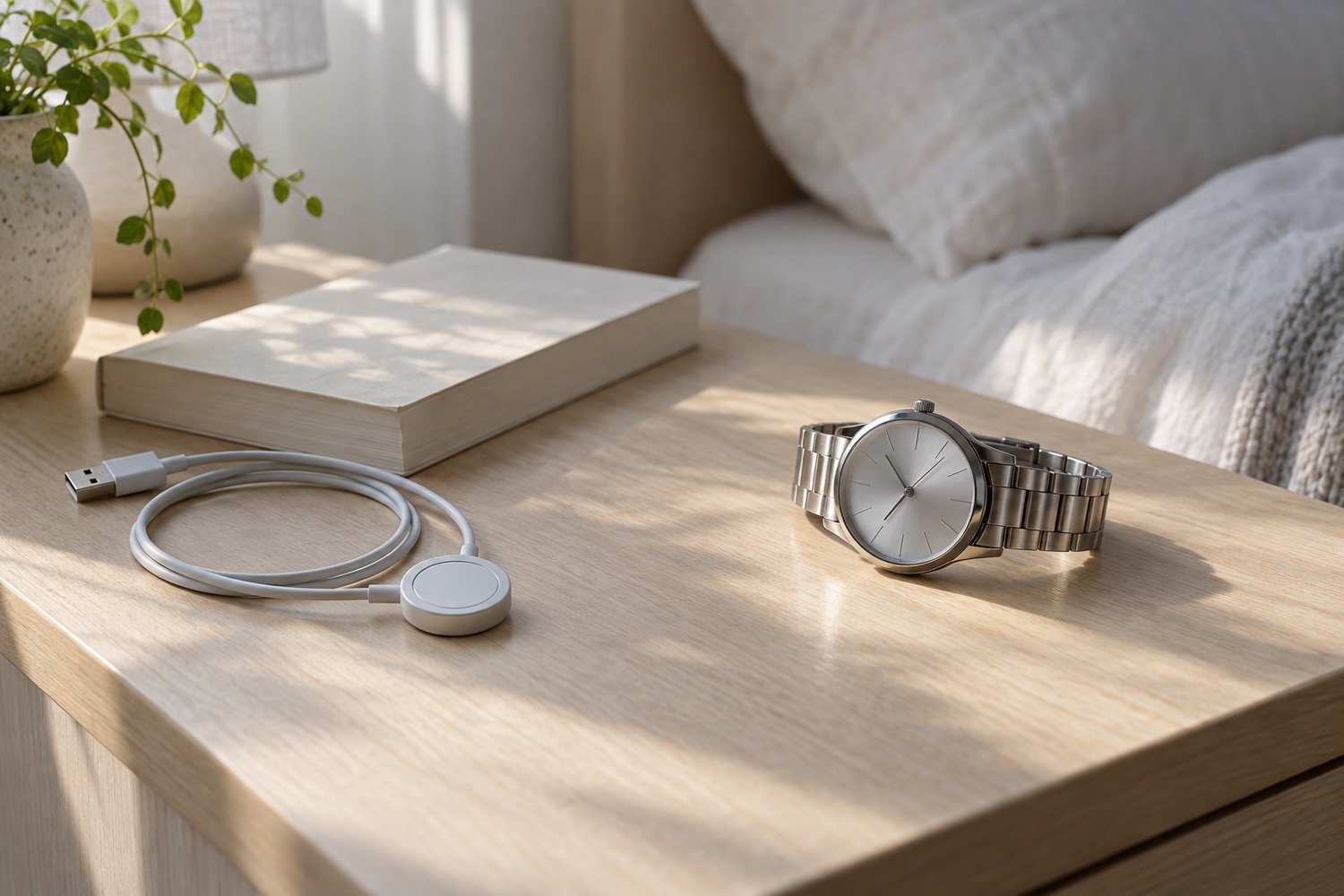
Every night the same small errand: take the watch off, find the cable, put it on the charger, remember it in the morning. Somewhere along the way, the thing on your wrist became another device to look after.
You can turn the notifications off. Most smartwatches let you silence nearly everything. What you can’t turn off is the charger.
This page is for anyone who has noticed that what they actually use their watch for is the time — and would like a watch that does only that, without asking anything of them each evening. It isn’t an argument against smartwatches. Plenty of people get real value from them. It’s for the ones who don’t, or no longer do.
I’m a designer in Japan, not a watch reviewer, and I haven’t worn these three watches. The specifications are Casio’s and Seiko’s own; prices and stock are from the shop this site links to.
What “never charging” really means
There are three ways a simple watch keeps going, and each asks something different of you. None asks for nothing.
A battery. A quartz watch with a battery that lasts years. You set it by hand, and every few years a watch shop replaces the battery. That’s the whole relationship.
Solar. The watch charges from any light — daylight, a desk lamp, the office ceiling. No cable, no battery changes on a schedule. You still set the time and the date by hand. The one thing it asks is not to live in a dark drawer for months.
Radio-controlled solar. Solar charging, plus the watch sets itself from official time signals broadcast by radio. You never charge it and you rarely touch the crown. It asks for a bit of luck with reception, which depends on where you live.
The step from smartwatch to any of these is the same: you stop plugging something in every day.
The quiet part
A watch with no connection to a phone has nothing to tell you except the time. No vibration when a message arrives, no reminder to stand up, no rings to close. That isn’t a setting you’ve chosen; it’s simply what the watch is.
For some people that’s the whole point. You look at your wrist, you see what time it is, and you look away.
Three simple watches, from least to most done for you
Prices are Discovery Japan Mall’s in yen on 16 September 2026, before shipping and any duties; all three were listed as in stock.
| Casio MQ-24-7BLLJH | Seiko SBPX143 | Seiko SBTM323 | |
|---|---|---|---|
| Power | Battery, about 3 years | Solar, about 10 months on a full charge | Solar, about 9 months; about 2 years in power save |
| Setting the time | By hand | By hand | Sets itself by radio signal |
| Date | None | Date | Date, full auto calendar to 2099 |
| Case | Resin, 38.8 × 34.9 × 7.8mm | Steel, 38.7mm wide, 9.6mm thick | Steel, 39.5mm wide, 9.5mm thick |
| Weight | 20g (0.7 oz) | 114g (4.0 oz) | 115g (4.1 oz) |
| Crystal | Resin | Sapphire | Sapphire |
| Water resistance | Daily use | 10 bar | 10 bar |
| Shop price | ¥2,730 (about $20) | ¥35,200 (about $240) | ¥55,000 (about $375) |
The lightest thing on your wrist: Casio MQ-24-7BLLJH
Who it suits. Someone who wants the least watch possible. Three hands, a plain dial, and nothing else.
Why I chose it. It’s the purest version of “just the time”. Casio’s specifications list no alarm and no sound functions at all, so nothing on it can beep. At 20g it’s lighter than most smartwatch bands on their own. And at under ¥3,000, it’s a low-risk way to find out whether you actually like going back to a plain watch before spending more.
Casio’s specifications. Case 38.8 × 34.9 × 7.8mm (1.53 × 1.37 × 0.31 in); 20g; resin case and band; resin crystal; daily-use water resistance; battery life about 3 years; accuracy ±20 seconds a month; band fits 145–205mm wrists.
What it asks of you. Setting the time by hand, including after daylight saving changes, and a battery change every few years. The resin crystal scratches more readily than sapphire, and daily-use water resistance means hand-washing and rain, not swimming. The shop lists it as coming in a blister pack with its manual and warranty card.
A plain steel Seiko that runs on light: Seiko Selection SBPX143
Who it suits. Someone who wants a watch that looks at home with a shirt or a sweater, and never wants to think about a battery.
Why I chose it. It’s about as simple as a steel watch gets while still being properly built: three hands, a date and nothing else on the dial, with a sapphire crystal and 10 bar water resistance. Seiko rates it at about 10 months of running from a full charge, so ordinary daily wear keeps it going. For someone leaving a smartwatch, it’s the most direct swap: no charger, no notifications, and a watch that still feels substantial on the wrist.
Seiko’s specifications. Caliber V157 solar quartz; accuracy ±15 seconds a month; about 10 months from a full charge; overcharge prevention and quick start; date. Stainless steel case 44.4mm long, 38.7mm wide and 9.6mm thick (1.75 × 1.52 × 0.38 in); sapphire crystal; stainless bracelet with a one-push three-fold clasp, fitting wrists up to 205mm (8.1 in); 10 bar water resistance; magnetic resistance; 114g (4.0 oz).
What it asks of you. Light, some of the time. Setting the time by hand. Seiko’s specification lists a date function rather than an automatic calendar, so check the manual for adjusting the date after shorter months. The bracelet will almost certainly need links removed. At 114g it weighs more than many smartwatches — worth knowing if the reason you’re switching is comfort.
The one you never charge and never set: Seiko Selection SBTM323
Who it suits. Someone who wants to forget the watch exists as a thing to maintain — the closest a simple watch comes to how a smartwatch always shows the right time.
Why I chose it. It’s the fullest answer to “I don’t want to look after my watch”. Solar charging removes the charger; radio time correction removes setting the time; the full auto calendar removes adjusting the date. The dial stays a simple three-hand design. It’s the most expensive of the three, and the price is for what it takes off your plate, not for looks.
Seiko’s specifications. Caliber 7B72 radio-controlled solar; about 9 months from a full charge, about 2 years in power-save mode; ±15 seconds a month when not receiving a signal; receives the time signals of Japan, China, the US, Germany and the UK, with automatic and manual reception, time-difference adjustment and automatic hand-position correction; full auto calendar to 31 December 2099. Stainless steel case 46.1mm long, 39.5mm wide and 9.5mm thick (1.81 × 1.56 × 0.37 in); sapphire crystal with Seiko’s Super Clear coating; Lumibrite on the hands and indices; bracelet with a one-push three-fold clasp, up to 195mm (7.7 in); 10 bar; magnetic resistance; 115g (4.1 oz).
What it asks of you. Reception isn’t guaranteed. Radio time signals depend on distance from the transmitter and on where the watch spends the night, and a big building or a long way from the US transmitter can mean it doesn’t pick one up. When that happens it simply runs as an accurate quartz watch until you set it. The bracelet maximum of 195mm is on the small side for larger wrists, so measure first.
What you give up
Being honest about this matters, because a watch isn’t a like-for-like replacement for a smartwatch.
- Fitness and health data: steps, heart rate, workouts, sleep.
- Safety features: on watches that have them, fall detection and emergency calling.
- Convenience: contactless payment, directions, answering a call.
If any of those are why you wear a watch, a simple one won’t replace it. Plenty of people end up with both: the smartwatch for a run, a simple watch for everything else. There’s nothing wrong with that arrangement.
Before you buy
- Measure your wrist. The two Seikos list a maximum wrist size (205mm and 195mm); the bracelets will need sizing down for most people, which a local watch shop can do.
- Think about weight. 20g and 115g feel very different. If comfort is part of why you’re leaving the smartwatch, the Casio is the change you’ll notice.
- Check the warranty. These are Japanese domestic models; see below.
- Decide what “simple” means to you. No date at all (the Casio), a date you set (SBPX143), or a watch that handles all of it (SBTM323).
If you’re choosing a simple watch as a gift for someone else, a watch that won’t interrupt you takes that angle, with three different watches. For more on Japanese-market references in general, see JDM watches worth importing.
Ordering from Japan
Okurimono Japan doesn’t sell anything. “Check Price” takes you to the product page at Discovery Japan Mall, an independent Japanese retailer — not Casio’s or Seiko’s own shop. You order, pay and arrange any return there, on its terms. If you buy through a link here, we may earn a commission at no extra cost to you.
- Prices and stock change. The figures above were checked on 16 September 2026.
- Duties and taxes. The shop’s Customs Duties page says they aren’t included and are collected on delivery. What changed for US buyers is in ordering from Japan to the US.
- Warranty. The shop’s Returns & Exchanges page says Japanese domestic models carry the domestic warranty only in Japan unless a worldwide warranty card is included, and that warranty repairs mean shipping the watch to Japan at your cost.
- Returns. Damaged, defective or incorrect items only, reported within 7 days of delivery. No change-of-mind returns.
More on how ordering works is on How to Buy.
One more thing
The appeal isn’t really about technology. It’s about the watch asking nothing of you. You put it on in the morning, it tells you the time all day, and at night it doesn’t need you to remember anything. For a lot of people, that turns out to be enough.
Sources
Checked 16 September 2026.
- Seiko Japan product pages: SBPX143 and SBTM323 — caliber, power reserve, reception, calendar, case, crystal, water resistance and weight.
- Casio Japan specifications for the MQ-24-7BLLJH — case, weight, battery life, accuracy and band range.
- Discovery Japan Mall product listings — prices, stock and listed contents; Customs Duties and Returns & Exchanges.
Frequently asked questions
- Can't I just turn off notifications on my smartwatch?
- Yes, and if that's all that bothers you, try it first. What you can't turn off is the charging. A simple quartz or solar watch removes that part of the routine, and because it has no connection to a phone, there's nothing for it to buzz about in the first place.
- Does a solar watch really never need charging?
- It never needs a charger, but it does need light. Seiko lists the SBPX143 at about 10 months of running from a full charge and the SBTM323 at about 9 months, or about 2 years in power-save mode. Worn on the wrist and left somewhere light at night, that's usually enough. Kept in a dark drawer for months, it will run down.
- What's the difference between solar and radio-controlled solar?
- A solar watch charges from light; you still set the time and date yourself. A radio-controlled solar watch also sets itself by receiving time signals. Seiko lists the SBTM323 as receiving the signals from Japan, China, the US, Germany and the UK, with a full auto calendar to 2099 and automatic hand-position correction.
- Will the Seiko SBTM323 set itself in the US?
- It's designed to receive the US time signal, but reception isn't guaranteed. It depends on where you live and where the watch sits overnight; inside large buildings or far from the transmitter, it may not pick the signal up. When it doesn't receive a signal, Seiko rates it at ±15 seconds a month.
- Is a battery watch a step backwards?
- Not necessarily. Casio rates the MQ-24's battery at about 3 years. That's one visit to a watch shop every few years, against charging a device every day or two. It's the cheapest and lightest of the three here, at 20g.
- What do I give up by switching?
- Everything a smartwatch does besides telling the time: fitness and heart-rate tracking, sleep data, contactless payments, maps, and safety features such as fall detection or emergency calls. If you rely on any of those, a simple watch isn't a like-for-like replacement, and you may prefer to wear one only on some days.
- Are these Japanese-market models covered by warranty outside Japan?
- Check before you buy. Discovery Japan Mall, the shop linked here, says Japanese domestic models carry the domestic warranty only in Japan unless a worldwide warranty card is included, and that warranty repairs mean shipping the watch to Japan at your cost.