G-SHOCK Began With a Broken Gift: How a Japanese Watch Won Over America
 By Kotaro·Updated Sep 17, 2026·9 min read
This guide contains affiliate links: if you buy through one, the shop may pay me a small commission at no extra cost to you. How I choose and how I earn
How a Casio engineer's broken watch led to the first G-SHOCK in 1983, how the shock-resistant structure works, and how the watch found its first real following in the United States — among people who worked in tough conditions, then skaters and snowboarders — before coming back to Japan. Based on Casio's own accounts, with sources.
The story of G-SHOCK usually starts with a watch hitting the floor.
In 1981, Kikuo Ibe, an engineer at Casio in Tokyo, dropped a watch and it broke. In Casio’s UK telling of the story, it was a watch his father had given him (Casio, “Built Different”). Other Casio accounts describe it simply as a watch he happened to drop at work, and don’t mention where it came from (G-SHOCK, “Origin of G-SHOCK”). Either way, what came next is well documented: a one-line proposal for “a durable watch that would not break even if dropped”, and two years of work to make it real.
The detail about the father is the reason this site, which is about gifts, finds the story worth retelling. A present that breaks is disappointing in a way that has little to do with its price. The thing that was lost was the fact of having been given it. Whether or not that feeling was part of Ibe’s motivation — and his own accounts don’t say — the watch he went on to design is one you don’t have to handle carefully, which is part of why it can make a good present.
This is a history built mostly on Casio’s own retrospectives, interviews and product pages. Where those sources disagree, this page says so.
A watch that could be dropped
At the start of the 1980s, a wristwatch was generally treated as a delicate instrument. Diver’s watches were specialist tools; everyday watches were expected to break if they fell. Casio, which had entered the digital watch market in 1974, was known mainly for calculators (Casio Integrated Report 2023, “Casio’s Power to Build Brands”, pp. 25–28).
Ibe’s proposal went against the fashion of the time, which favoured thin, dressy watches. In a 2023 conversation published in Casio’s integrated report, Casio’s president Yuichi Masuda, who joined the project as its planner, recalled that the idea met resistance at the first planning meeting and went ahead after a senior executive, Kazuo Kashio, told the team to try it if they thought they could make it work. Masuda also said that “tough” was probably a closer description of the idea than “unbreakable”.
Project Team Tough was set up in 1981 with three members. Over about two years, Casio says, the team built more than 200 prototypes. The first G-SHOCK, the DW-5000C, went on sale in April 1983 (G-SHOCK, “History”; Integrated Report 2023).
The development goal had a name: Triple 10. It meant shock resistance to survive a fall of 10 meters, water resistance to 10 bar, and a battery life of 10 years (G-SHOCK, “The History of Triple 10”).
That was the target, not the label on the finished watch. According to Casio’s own page on Triple 10, the DW-5000C shipped with 20-bar water resistance, shock resistance meeting the ISO and JIS standard for a free fall from 1 meter, and a 7-year battery. Some of Casio’s marketing pages describe the first model’s battery as lasting 10 years. This article follows the Triple 10 page, which deals with the specification directly.
A rubber ball in a park
The testing ground was a third-floor window at Casio’s research and development center. Casio’s accounts describe Ibe dropping prototypes to the ground below, looking at what had broken, reinforcing it, and dropping the watch again.
His first thought was to wrap the whole watch in soft, shock-absorbing material. It didn’t work. However much rubber went on the outside, parts inside still broke, and the extra padding made the watch bigger. One test piece, Casio says, ended up about the size of a softball. A layered cushioning design solved the size problem, but then a different electronic component would fail in each test. Strengthening one simply moved the failure to the next.
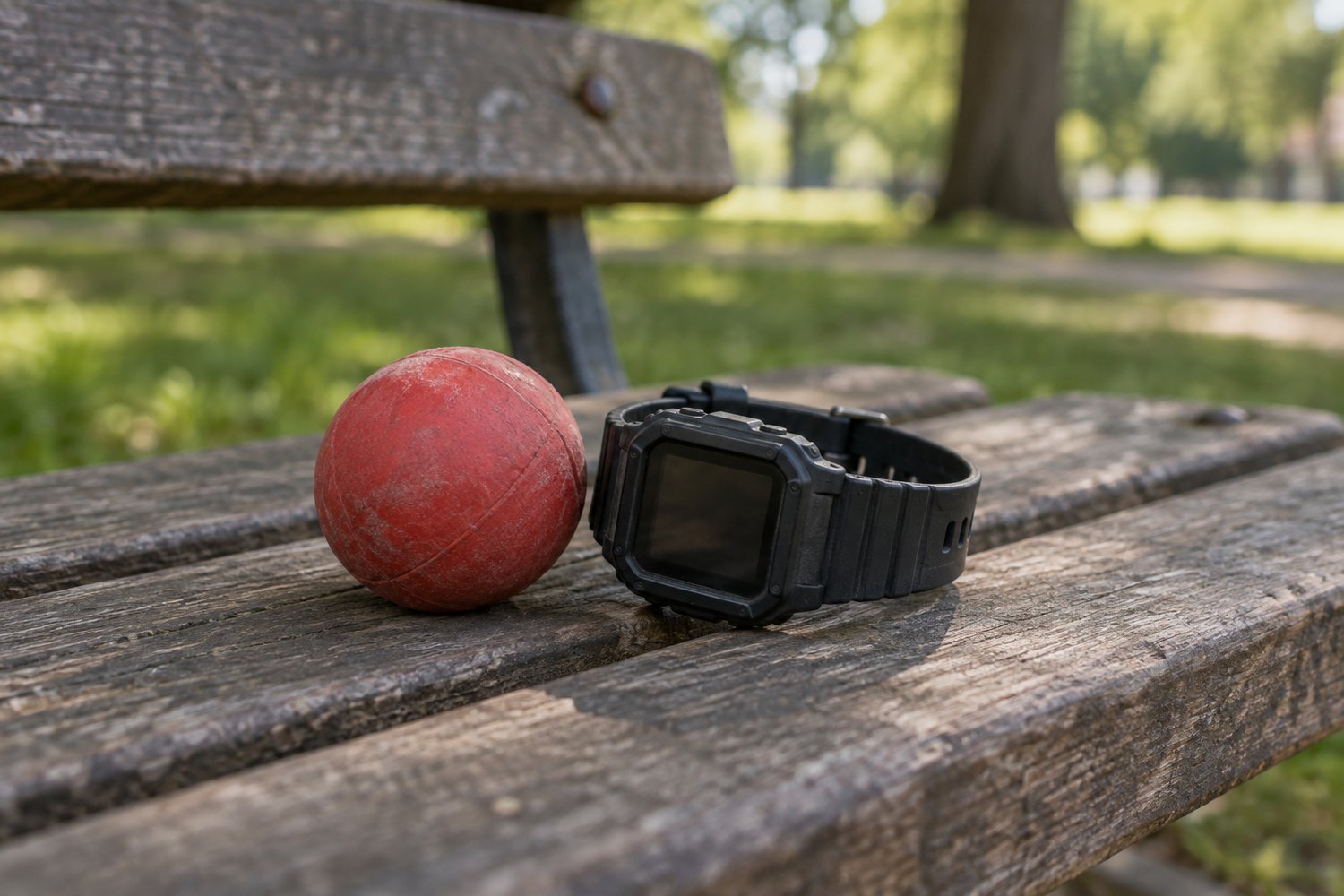
The breakthrough came, in Casio’s telling, close to the deadline. After a week of working on nothing else, Ibe went into a park next to the office on a Sunday and watched children playing with a rubber ball. It gave him the idea that a watch’s module — the electronic core that actually keeps time — could sit inside the case the way the air sits inside a ball, protected from the shock that hits the outside (G-SHOCK Development Story).
Casio’s corporate account describes the result carefully: a hollow structure in which the module is supported at just a few points, with a slight space around it.
Why a G-SHOCK takes a knock
Casio sometimes says the module “floats”. It isn’t literally suspended in air, or held by magnets. It is mounted inside a hollow case at a small number of points, so that less of an impact’s force reaches it (G-SHOCK, “History”). Around that core, Casio describes several layers of protection that work together (G-SHOCK, “Shock resistance”):
- The bezel, the raised ring around the face, sits proud of the glass and buttons. If the watch lands on its face or side, the bezel takes the blow first.
- The strap is shaped with a stiff curve where it meets the case, so it can absorb shock rather than let the back of the case take a direct hit.
- Cushioning inside the module guards small, critical parts such as the crystal oscillator, which keeps the time.
- The hollow case structure is the original idea from 1983, keeping the module from bearing the full force of an impact.
This is why a classic G-SHOCK looks the way it does. The thickness, the raised edges and the chunky strap are not only styling. They are the protection.
Casio also notes that the structure has been developed further since 1983, so not every G-SHOCK generation is built identically inside. And shock resistance is not a promise that a watch can survive anything. It means the watch is designed to withstand the kinds of impacts described in its specification.
First fans: people who worked in tough conditions
The DW-5000C did not take off at home. In the 2023 dialogue, Masuda recalls that there was “almost no reaction at all” in Japan at first. A Casio retrospective puts it the same way: the thick, sturdy watch was at odds with a Japanese market that wanted thin ones (Casio Note, “What was the catalyst for the G-SHOCK breakthrough?”, a machine-translated post from November 2024).
The United States was different. According to Masuda, sales grew there, with particular support among firefighters, police officers, military personnel and others who worked in demanding environments. That is Casio’s recollection of who was buying and wearing the watch. It isn’t a claim of official adoption by any service.
The reason seems practical rather than cultural. A watch that could be knocked against a ladder, a door frame or a truck, and that coped with water, matched what those jobs asked of it. For how that plays out today — on a trail, a job site or a snowboard slope — see 3 times you’ll be glad you’re wearing a G-SHOCK outdoors.
The hockey commercial
Casio then leaned into that reputation. According to Casio’s retrospective, a television commercial aired across the US in 1984 showed an ice hockey player hitting a G-SHOCK like a puck, with the goalkeeper catching it.
Casio says many viewers didn’t believe it, and that television programs which checked popular claims received inquiries about it. One program, Casio says, recreated the scene and found the watch still worked. It went further and had a large truck drive over one, which it also survived. Casio doesn’t name the program, and this article doesn’t either.
The commercial’s lasting contribution was probably simple. You don’t need to understand a hollow case structure to understand a watch being hit across the ice. It showed the idea in a few seconds. (Please don’t try it yourself. The test is a demonstration, not a care instruction.)
Masuda’s own view, in the same interview, is that toughness alone wouldn’t have built the brand G-SHOCK became. What happened next mattered as much.
Skaters, and a return to Japan
Casio’s marketing then reached beyond professionals. Shigenori Itoh, who later ran Casio America, recalled in the 2023 dialogue that the company supported snowboarders, skaters and surfers with samples and product support. For people who fell a lot as part of their sport, a watch built for impact made obvious sense. Over time it also became part of how they looked.
Casio’s timeline names one model in particular. The DW-5900C, with its three round displays, became popular with skateboarders on the US West Coast after it was first released outside Japan in 1990. Casio’s timeline lists it under 1992 and credits it with helping start a G-SHOCK boom in Japan once musicians and other trendsetters there began wearing it (G-SHOCK, “History”).
Casio’s accounts describe the return to Japan as a “reverse import”. Masuda recalls sales starting to rise quickly in Japan around 1989 to 1990, and says the company traced it to American popularity being reported in magazines and other media. Itoh, who joined G-SHOCK work in 1993, describes building on that with a campaign under the slogan “America loves G-SHOCK”. Casio’s retrospective places the biggest Japanese boom in the late 1990s, alongside street fashion. Put together, the picture is of a popularity that built in waves over most of a decade, across different places and groups, rather than a single moment.
A shape people kept coming back to
In 1995 Casio released the DW-6900, with a rounder case, a front button and three circular graphic displays. Casio’s own catalogue for the series’ 25th anniversary shows how it became a canvas for collaborations. They include the graffiti artist Eric Haze in 1999, the musician Eminem in 2013 and the artist FUTURA in 2016 (G-SHOCK, 6900 series catalogue, 2020). Those were limited editions of their time and aren’t generally available now.
What the collaborations show is how far the reasons for wearing a G-SHOCK had travelled. People first chose it for what it could survive. Later they also chose it for its colours and shapes, and for the scenes it had become part of. The toughness never went away, but it stopped being the only reason.
A watch that started with a gift
It’s fitting that a watch whose origin story, in at least one of Casio’s tellings, begins with a gift from a father can make a good gift itself.
The history is a good reason to be interested in G-SHOCK, but it isn’t a reason on its own to buy one. The right one for someone depends on their wrist, what they wear, how they spend their days and which features they’d actually use.
I was given my first G-SHOCK in high school, and wrote about that, and the three I’d choose today. If you’re choosing for a teenager, see a first G-SHOCK for a child starting high school. More watches are in the Watches category.
Sources
All are Casio publications unless noted. Where they differ, the article says which it follows.
- Casio UK, Built Different: the father’s gift; 1981; Project Team Tough; over 200 prototypes. It also gives a 10-year battery life for the first model, which differs from the Triple 10 page.
- G-SHOCK, Five Stories: #01 Origin of G-SHOCK: the one-line proposal, drop tests, the softball-sized prototype and the rubber ball in the park.
- Casio, G-SHOCK Development Story: the third-floor tests and the module supported at a few points.
- G-SHOCK, The History of Triple 10: the goal and the DW-5000C’s actual specification.
- G-SHOCK, Shock resistance: bezel, strap, cushioning and hollow case.
- G-SHOCK, History: 1981 team, 1983 DW-5000C, the DW-5900C (listed 1992, first released outside Japan 1990) and the 1995 DW-6900.
- Casio Note, What was the catalyst for the G-SHOCK breakthrough? (November 2024, machine-translated from Japanese): the 1984 hockey commercial, the TV verification and the reverse import.
- Casio Integrated Report 2023, Casio’s Power to Build Brands (printed pages 25–28): dialogue between Yuichi Masuda and Shigenori Itoh.
- G-SHOCK, 6900 series catalogue (2020): collaboration timeline.
Frequently asked questions
- Who invented the G-SHOCK?
- Casio credits engineer Kikuo Ibe with the idea of a watch that wouldn't break when dropped. A three-person project team, Project Team Tough, was formed in 1981, and the first G-SHOCK, the DW-5000C, went on sale in April 1983.
- What does 'Triple 10' mean?
- It was the development goal: shock resistance to survive a 10-meter drop, 10-bar water resistance and a 10-year battery. Casio says the first model actually shipped with 20-bar water resistance, shock resistance meeting the ISO and JIS standard for a 1-meter free fall, and a 7-year battery. The goal and the final specification are different things.
- Is a G-SHOCK unbreakable?
- No. 'A watch that won't break even if dropped' was the idea behind it, and Casio's own president has said 'tough' describes it better than 'unbreakable'. Shock resistance means the watch is built to withstand impacts like drops in everyday use, within the limits of each model's specification.
- Why did G-SHOCK become popular in America first?
- By Casio's account, early sales in Japan were weak, while in the US the watch found support among people working in demanding conditions, such as firefighters and police officers. A 1984 TV commercial showing the watch used as a hockey puck drew attention, and skaters, snowboarders and surfers later adopted it. Popularity then travelled back to Japan through magazines.