3 Times You'll Be Glad You're Wearing a G-SHOCK Outdoors
 By Kotaro·Updated Sep 16, 2026·12 min read
This guide contains affiliate links: if you buy through one, the shop may pay me a small commission at no extra cost to you. How I choose and how I earn
Where a G-SHOCK actually earns its place: reading altitude on a climb, taking knocks in a garage or on site, and staying on your wrist through a snowboard fall. Three Japanese-market models, with Japanese owner reviews and what to check first.
A spec sheet can tell you a watch is shock resistant to 20 bar with a triple sensor. It can’t tell you when that matters.
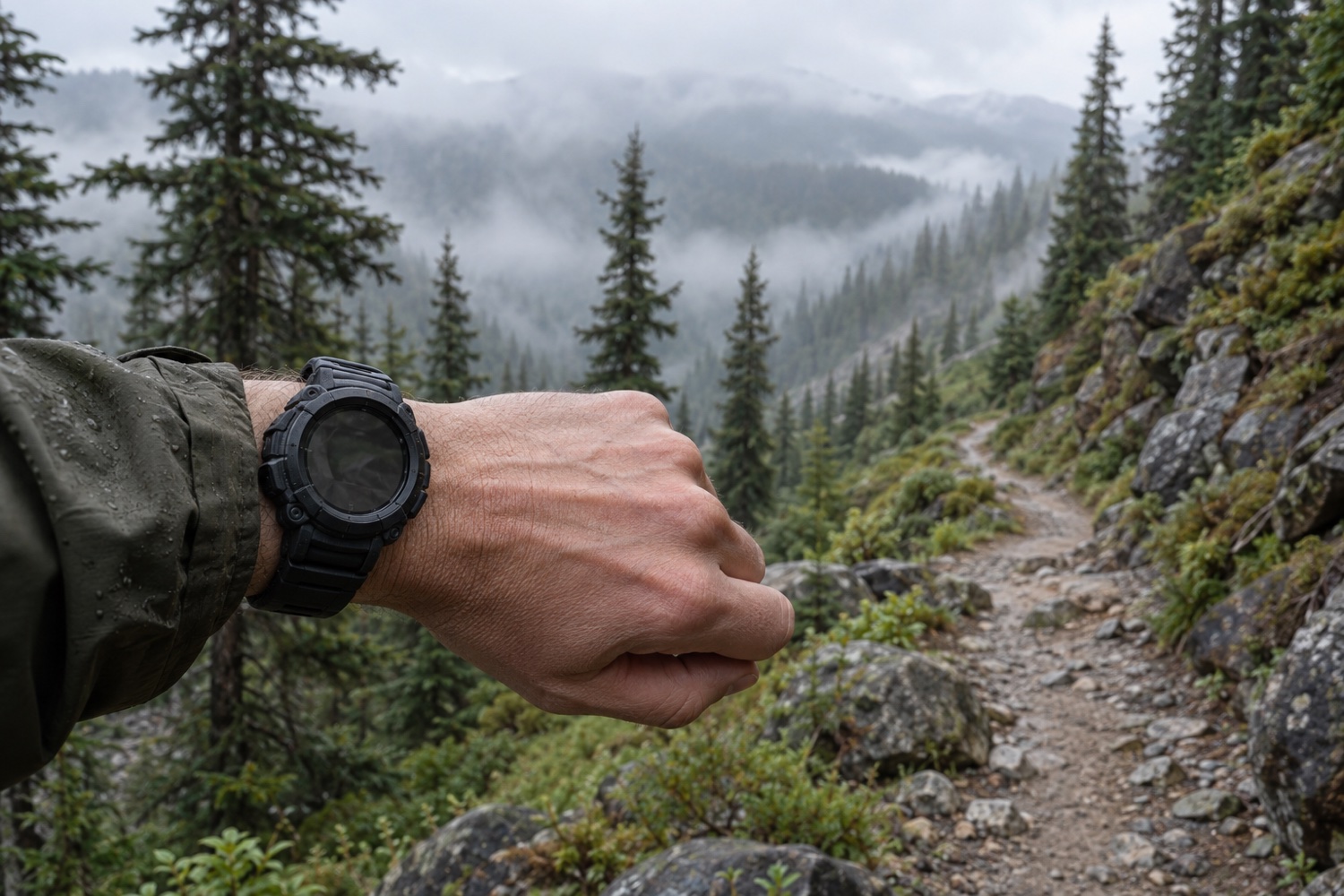
It matters on a climb where the trail is still under trees and the summit is nowhere in sight, and you’d like to know how much of the ascent is behind you. It matters when you’re reaching into an engine bay and your wrist meets a metal edge. It matters when you catch an edge on a snowboard and land hard, with snow going up your sleeve and a phone buried under a glove and a jacket.
This page takes three of those moments, one at a time. For each, it says what the situation actually asks of a watch, what Japanese owners say about a model built for it, which Japanese-market G-SHOCK suits it, who it makes sense as a gift for, and what to know before you order. If you want the story of how the line started, that’s in G-SHOCK began with a broken gift; this page stays with what the watches do now.
Specifications are Casio’s own, from its Japanese product pages. Prices and stock are Discovery Japan Mall’s on 16 September 2026 and change without notice. I haven’t worn these three watches, so everything here is either the maker’s information or someone else’s, attributed.
1. On the climb, when you want to know how far you’ve come
You’re an hour and a half in. The trail is switchbacks under trees, the summit is hidden, and the signal on your phone comes and goes. You’d like to know your rough altitude, whether the pressure is falling, and which way the ridge you can half-see is actually facing — without stopping, unzipping a pocket and waking a phone every twenty minutes.
That’s the case for a triple-sensor G-SHOCK. On the RANGEMAN, one press of a sensor button gives altitude; another gives pressure and temperature; another gives a bearing. When the summit is still behind the trees, the altimeter is a second way to judge how much climbing may be left, and the barometer’s 42-hour trend graph is a way to notice that the weather is changing before you feel it.
What Japanese owners say. On kakaku.com, where the GW-9400BJ-1JF has an average of 4.65, one reviewer writes that because the watch derives altitude from air pressure, calibrating before you set out is essential, and that when he tested it in stable pressure it measured fairly accurately. He also values the alarm that fires when the pressure changes sharply, as advance warning of the weather turning, and says the compass gets used more than he expected — in the hills and around town. His complaint is specific: wearing gloves and putting his left hand down can press a button by accident (kakaku.com reviews, GW-9400BJ-1JF, checked 16 September 2026).
In Casio’s own review section for this reference, which shows an average of 4.2 from six reviews, the notes are mixed in a useful way: one owner replaced the same model after about 13 years of wear, and another writes that legibility is this version’s weak point and that the standard-display version might have suited him better (Casio Japan, GW-9400BJ-1JF, checked 16 September 2026).
The watch. Casio lists the GW-9400BJ-1JF with a shock-resistant structure, 20 bar water resistance, Tough Solar charging, MULTIBAND 6 radio time correction, and a triple sensor: relative altimeter (−700 to 10,000m, with altitude memory and a difference graph), barometer (260–1,100 hPa, 42-hour trend graph, pressure-change alarm), digital compass (16 directions, magnetic declination correction) and thermometer (−10 to 60°C). Case 55.2 × 53.5 × 18.2mm, 93g, resin case with a carbon-fibre insert band that fits wrists of 145–215mm. From a full charge with no light at all, Casio quotes about 8 months of use, or about 23 months in power saving. Without a radio signal it keeps normal quartz accuracy, about ±15 seconds a month.
Casio is explicit about the limitation: this is a relative altimeter that converts pressure change into altitude, so if the weather shifts, the altitude reading shifts with it. Calibrate at a known elevation before you start, re-calibrate at marked points, and treat the numbers as information rather than as navigation. It doesn’t replace a map, a hiking app, a dedicated GPS unit or the rest of the safety kit.
The shop lists it at ¥52,514, in stock when checked, with the watch, box, instruction manual and warranty card included.
Who it suits as a gift. The father who walks a route most weekends and likes knowing the numbers. The husband who has moved from day hikes to real mountains. The hiker who doesn’t want to depend on a phone for everything, and who would rather glance at a wrist than dig out a handset in the cold.
Before you buy. It’s a large watch — 55mm tall and 18mm thick — and on a slim wrist it reads as a lot of watch; check what they wear now. This particular reference has a reverse display, which is the one thing owners disagree about, so if the person values a plain, high-contrast readout, consider the yellow version below, which has a standard display and was also listed at the shop on 16 September 2026, at ¥60,016.
2. At work, when the watch hits something hard
A ladder goes up, a length of timber goes on a shoulder, and a wrist catches the scaffold on the way past. An arm goes into a wheel arch and comes out against a bracket. A morning in a field ends with dust in everything. None of this is dramatic. It’s just what the day involves.
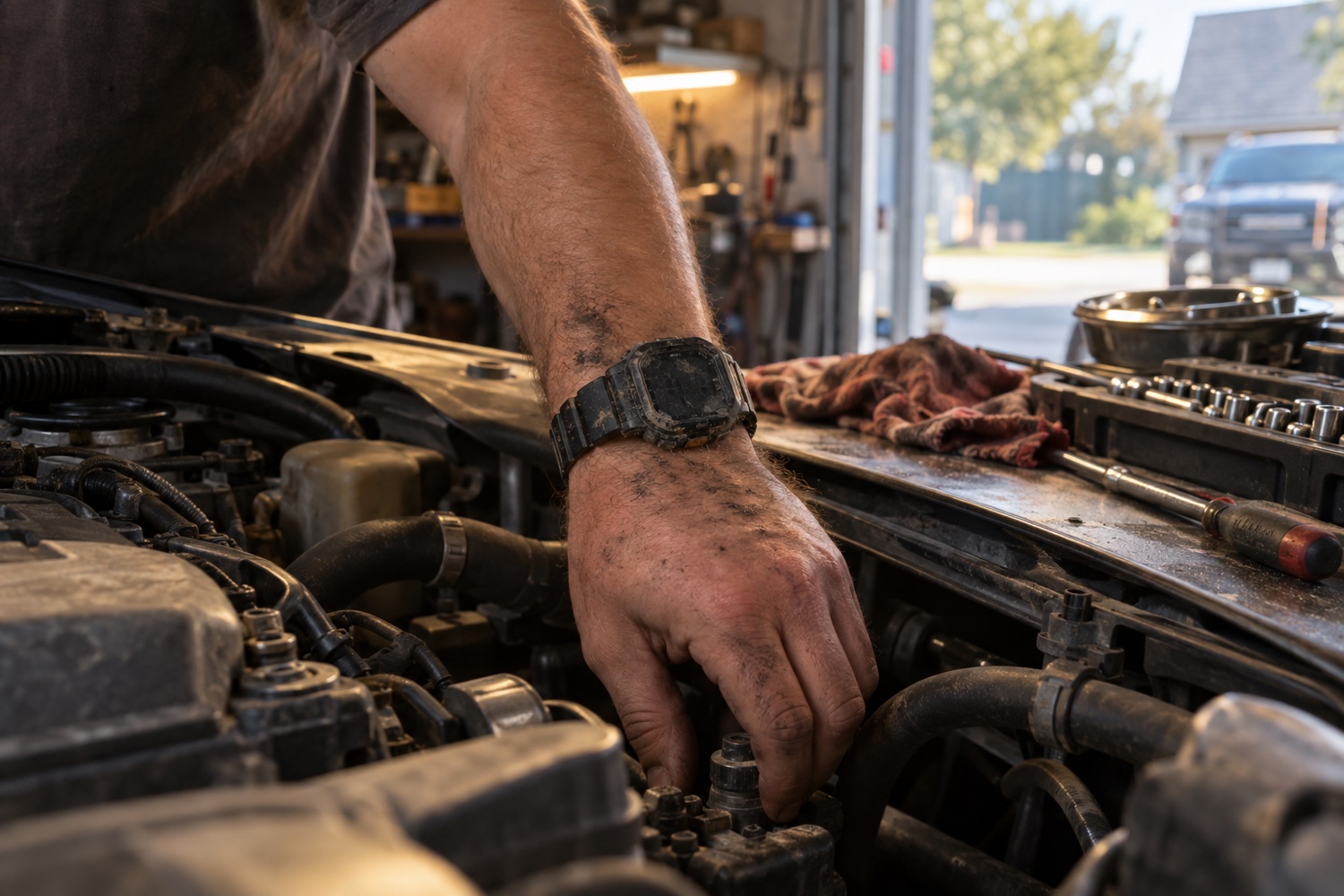
A watch that worries you is a watch you take off before work — and then it isn’t doing anything. The argument for a G-SHOCK here is ordinary and practical: it’s a watch you don’t have to treat delicately. Its shock-resistant construction means less reason to stop and inspect a scratch, and the MUDMAN adds a mud- and dust-resistant structure to that, which is the part that matters when the day ends with a hose rather than a cloth.
What Japanese owners say. A buyer reviewing a MUDMAN on BicCamera’s site — note that this is the GW-9500MEC-1JF, a different reference in the same MUDMAN line, with a 4.8 average from six reviews — writes that he went in intending to buy a RANGEMAN, but that because sand and mud get on him at work, he was talked round to the MUDMAN for durability, and that after repeatedly getting muddy, a quick rinse keeps it clean. Another owner of that reference says the absence of a crown makes it more practical than an analogue watch and that it’s light for what it is; he also says the thermometer is meaningless while the watch is on your wrist, that the compass and barometer are relatively accurate, and that the altimeter is fine if you correct it often but drifts when the weather changes a lot (BicCamera reviews, GW-9500MEC-1JF, checked 16 September 2026).
For the reference linked here, Casio’s own review section shows an average of 4.6 from seven reviews; one owner writes that the display is large and easy to check and that altitude, pressure and bearing each have their own button, so there’s no cycling through modes (Casio Japan, GW-9500-1JF, checked 16 September 2026). Another reports the altimeter at home moving between about −50m and +100m across a week — the same caveat as above, from a different owner.
These are individual impressions, not a durability test, and they don’t transfer to every G-SHOCK.
The watch. Casio lists the GW-9500-1JF with shock-resistant, mud-resistant and carbon core guard construction, 20 bar water resistance, Tough Solar, MULTIBAND 6, and the same family of sensors: compass, barometer with the 42-hour trend graph and pressure alarm, relative altimeter with climb records, and thermometer. Case 56.7 × 52.7 × 14.8mm, 81g, carbon-fibre-reinforced biomass plastic case and bezel, band 145–215mm. About 6 months of running from a full charge with no light, or about 26 months in power saving.
The shop lists it at ¥59,077, in stock when checked. Its listing doesn’t itemize what’s in the box, so ask if that matters.
Who it suits as a gift. The husband on site. The father who is outdoors with machinery or animals. The person who spends Saturday under a car, or building something that involves a lot of tool changes.
Before you buy. It’s still a big watch, and a 14.8mm case under a work jacket cuff catches. Sensor buttons stand proud, which is what makes them usable in gloves and also what makes them catch. Mud, sand and salt water need rinsing off and the manual’s care instructions followed, and a shock-resistant watch is designed to resist shock, not guaranteed to survive every impact. If the work involves a lot of overhead reaching in tight spaces, ask whether they’d wear a watch at all.
3. On the mountain, when you go down hard
You catch an edge, you land on a forearm, snow gets inside the cuff, and you sit up wondering what time the group said they’d meet. Your phone is under a glove, a jacket and a pass pocket. Taking a glove off on a cold lift is its own small penalty.
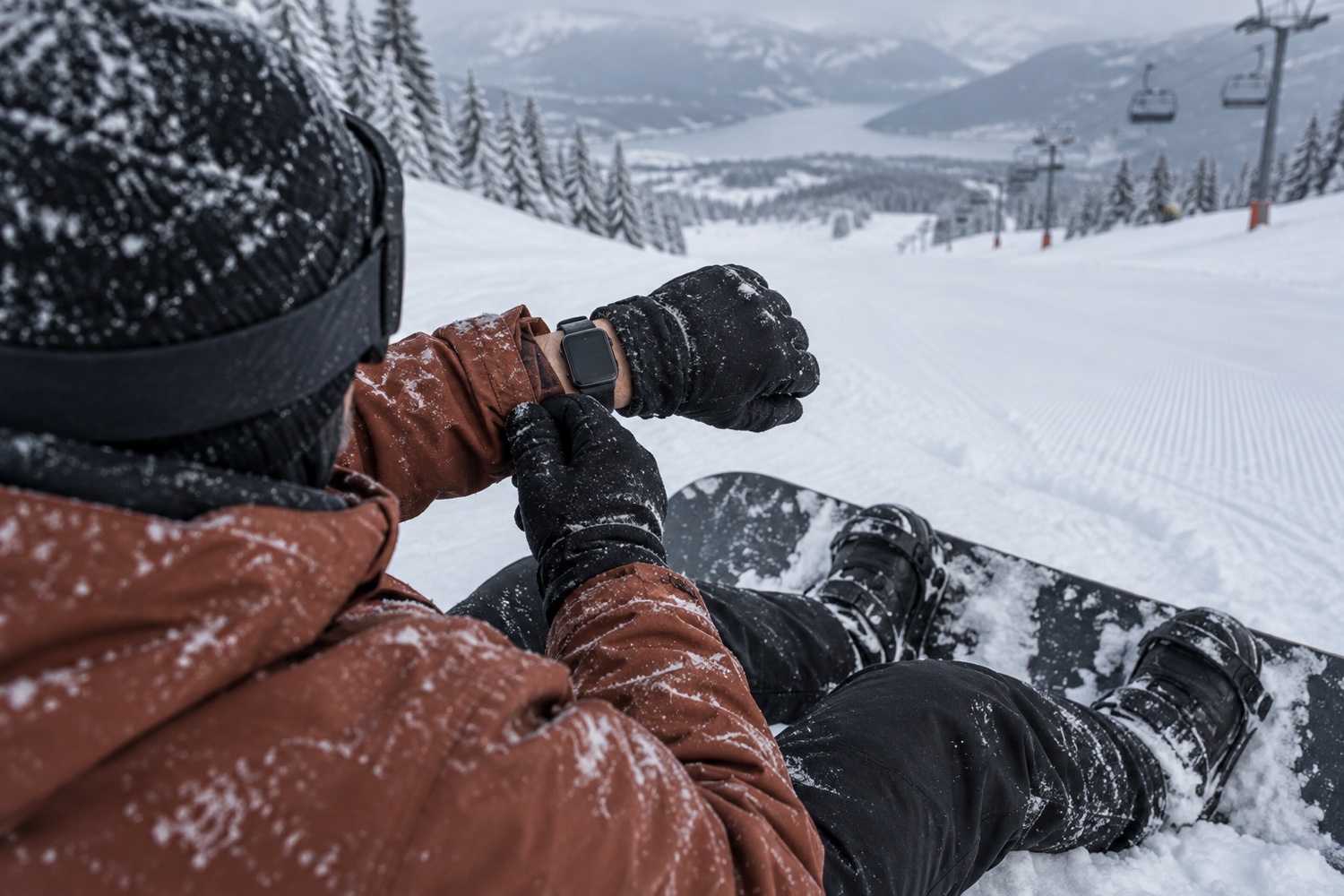
This is the case for something light, legible and easy to knock: a watch you can glance at with the goggles still on. The GBD-200 is the small square in this group — 58g against the RANGEMAN’s 93 — with a MIP display and 20 bar water resistance, and its phone link means messages land on the wrist rather than in a pocket you can’t reach.
What a Japanese professional snowboarder says. In a Casio-published interview on the TEAM G-SHOCK site, Japanese professional snowboarder Yuto Totsuka says he wears the GBD-200-1JF when he snowboards, that it helps with planning training time and calorie tracking, and that having notifications appear on the display is welcome because it means not pulling a phone out of a pocket — useful, he says, for snowboarders who always have gloves on (TEAM G-SHOCK, favourite watches, checked 16 September 2026). This is an athlete testimonial published by Casio, rather than an independent customer review, and he is a sponsored rider.
For ordinary buyers, Casio’s review section for this reference shows an average of 4.4 from 37 reviews, and the most useful one is critical: an owner who bought it specifically to stop charging a smartwatch lists what he misses — the stopwatch doesn’t measure hundredths, there’s no hourly signal, reading a notification takes more than one button press, and timers and alarms really want to be set from the phone (Casio Japan, GBD-200-1JF, checked 16 September 2026).
The watch. Casio lists the GBD-200-1JF with a shock-resistant structure, 20 bar water resistance, a MIP LCD, Bluetooth time correction through the CASIO WATCHES app, notifications for calls, mail, SNS, calendar and reminders, step count and running data from an accelerometer with distance correction using the phone’s GPS, a stopwatch and interval timers, and an LED backlight. Case 48.4 × 45.9 × 15mm, 58g, resin, band 145–215mm. Battery life is about two years — this model is not solar, which is the single most common misunderstanding about it.
The shop lists it at ¥28,235, in stock when checked, with contents not itemized.
Who it suits as a gift. The son who goes up every winter. The partner who rides weekends and forgets to charge things. Someone who wants fewer reasons to take a glove off.
Before you buy. Notifications need a compatible phone and Casio’s app, and this is not a smartwatch: no touchscreen, no apps, no maps. Confirm the battery point above if the person assumed all G-SHOCKs charge from light. Whether the buttons work through thick gloves depends on the gloves and the hands, so it’s worth asking. And check the instruction manual for the operating conditions in cold weather before planning on it for a long day at altitude — battery chemistry and displays both behave differently in the cold.
The three side by side
| Situation | Useful features | Recommended model | Best gift recipient | Points to check before buying |
|---|---|---|---|---|
| Hiking, checking altitude | Relative altimeter, barometer with 42-hour trend and pressure alarm, compass, thermometer, Tough Solar, MULTIBAND 6, 20 bar | RANGEMAN GW-9400BJ-1JF (¥52,514) | Weekend hiker; someone moving into real mountains | 55.2 × 53.5 × 18.2mm and 93g; reverse display divides opinion; altimeter needs calibrating and moves with the weather |
| Site, farm, garage or DIY | Mud- and dust-resistant plus shock-resistant construction, 20 bar, triple sensor, Tough Solar, MULTIBAND 6, large buttons | MUDMAN GW-9500-1JF (¥59,077) | Construction worker; farmer; weekend mechanic | 56.7 × 52.7 × 14.8mm and 81g; buttons catch on cuffs; rinse and care after mud or salt water; resistant is not immune |
| Snowboarding and winter sport | MIP display, 20 bar, shock-resistant, phone notifications, stopwatch and interval timers, step and run data, 58g | G-SQUAD GBD-200-1JF (¥28,235) | Snowboarder; anyone who wants gloves to stay on | Battery, not solar (about 2 years); needs a compatible phone and Casio’s app; glove operation varies; check cold-weather conditions in the manual |
Choosing between them
The most capable model isn’t the best one for everyone. It’s the one whose features match where the watch will actually be.
If the person wants altitude and pressure while walking uphill, that’s the RANGEMAN. If their days involve dust, mud and knocks, that’s the MUDMAN — and it costs more than the RANGEMAN here, which is worth knowing if you assumed the sensors set the price. If what they want is a light square that shows the time and their messages while they’re wearing gloves, that’s the GBD-200, at less than half the price of either sensor model.
So the useful question isn’t which G-SHOCK is toughest. It’s where this watch will spend its Saturdays. For other ways into the line, see three G-SHOCKs chosen as gifts, a first G-SHOCK for a child starting high school, or the rest of the watches category.
Before you order
- The links go to a shop, not to us. “Check Price” opens the product page at Discovery Japan Mall, an independent Japanese retailer. You order and pay there, on their terms.
- Check price, stock, shipping and returns at the shop. The figures here were true on 16 September 2026 and change. How ordering from Japan works is on How to Buy.
- We may earn a commission if you buy through a link on this page, at no extra cost to you.
- Don’t lean on the ratings. Water resistance and shock resistance are design specifications, not promises. Follow Casio’s instruction manual, particularly on rinsing after mud or salt water, on pressing buttons underwater, and on use in the cold.
Sources
Checked 16 September 2026.
- Casio Japan product pages: GW-9400BJ-1JF, GW-9400YJ-1JF, GW-9500-1JF, GBD-200-1JF — specifications, sensor notes and the customer reviews quoted.
- kakaku.com owner reviews, GW-9400BJ-1JF — calibration, pressure alarm, compass use, glove button presses.
- BicCamera owner reviews, GW-9500MEC-1JF — a different reference in the MUDMAN line, quoted as such.
- TEAM G-SHOCK, favourite watches — Yuto Totsuka, an athlete testimonial published by Casio.
- Discovery Japan Mall product pages for each reference — price, stock and listed contents.
Frequently asked questions
- Is a G-SHOCK altimeter accurate enough for hiking?
- It's useful, not authoritative. Casio states the altimeter is a relative altimeter that converts changes in air pressure into altitude, so the reading moves when the weather moves. One Japanese owner of the GW-9400BJ-1JF writes that calibrating before setting out is essential, and that in stable pressure he found it measured fairly accurately. A MUDMAN owner reports his watch drifting between about −50m and +100m over a week at home. Treat it as a second opinion alongside a map, a hiking app and a forecast.
- Which of these three is best for construction, farm or garage work?
- The MUDMAN GW-9500-1JF. Casio lists it with a mud- and dust-resistant structure on top of the usual shock-resistant construction and 20 bar water resistance, and it charges from light, so there's no battery change to schedule. One Japanese buyer of a different reference in the same MUDMAN line says he chose it over the RANGEMAN because sand and mud get on him at work, and that a quick rinse cleans it.
- Does the GBD-200 charge from light?
- No. Casio lists the GBD-200-1JF with a battery life of about two years, not Tough Solar. If solar charging matters to the person you're buying for, that rules this model out — the RANGEMAN and MUDMAN here are both solar.
- Will the GBD-200 show phone notifications like a smartwatch?
- It shows notifications for calls, mail, SNS, calendar and reminders when paired with a phone running Casio's CASIO WATCHES app, but it isn't a smartwatch. One Japanese owner notes that reading a notification takes more than a single button press, and that timers and alarms are meant to be set from the phone.
- Are these watches unbreakable?
- No, and Casio doesn't claim that. They are designed to resist shock, and the two sensor models are rated at 20 bar, which is why people wear them for work and sport instead of taking a watch off. Any watch can be damaged. Follow the instruction manual, especially about water resistance after mud, sand or salt water.
- Are these big watches?
- The RANGEMAN and MUDMAN are. Casio lists the GW-9400BJ-1JF at 55.2 × 53.5 × 18.2mm and 93g, and the GW-9500-1JF at 56.7 × 52.7 × 14.8mm and 81g; both bands fit wrists of 145–215mm. The GBD-200-1JF is much smaller at 48.4 × 45.9 × 15mm and 58g. On a slim wrist, or under a jacket cuff, the difference is obvious.
- Can I read the reverse display of the black RANGEMAN?
- Opinions differ, and it's worth knowing before you buy. In Casio's own review section for the GW-9400BJ-1JF, one owner writes that legibility is the model's weak point and that the standard-display version might have suited him better; on kakaku.com another calls the same display surprisingly readable. The yellow GW-9400YJ-1JF has a standard display and was also listed at the shop.
- Do these come boxed, and will the shop gift-wrap them?
- The shop's listing for the GW-9400BJ-1JF says the set includes the watch, box, instruction manual and warranty card. The MUDMAN and GBD-200 listings don't itemize their contents, and no gift-wrapping service is listed for any of them. Check the product page, or ask the shop, before you count on presentation.