What Actually Goes in an Analog Bag
 By Kotaro·Updated Sep 16, 2026·7 min read
This guide contains affiliate links: if you buy through one, the shop may pay me a small commission at no extra cost to you. How I choose and how I earn
An analog bag only works if you open it. How to choose what goes in by how long your gaps actually are, the four slots worth filling, the small thing most people forget, and three Japanese tools that earn their space.
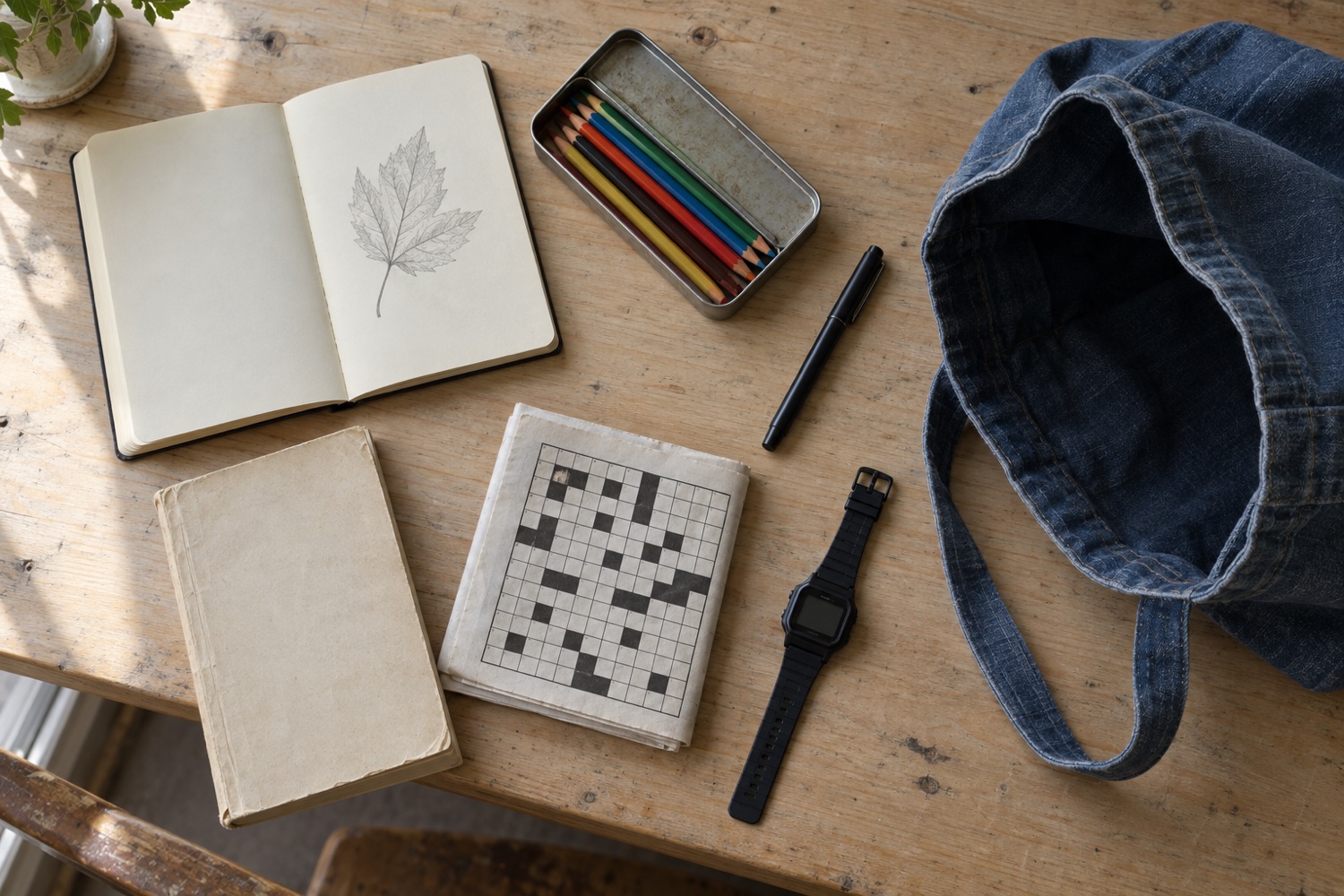
The idea is easy. You carry a small bag of things to do that aren’t a phone, and when a gap appears in the day, you open that instead.
What’s harder is the part nobody posts about: most first attempts are wrong. The bag gets heavy, so it stays home. Or it holds a watercolor kit that needs a table, water and twenty minutes, and the gaps you actually get are four minutes long at a bus stop. After a week, it’s a tote of unused objects by the door.
This page is about choosing what goes in. Not a shopping list, and not a rule about screens — just what tends to get used, and a few Japanese tools that earn their space.
Where the term came from
Marie Claire traced “analog bag” to Sierra Campbell, a content creator who swapped scrolling for knitting, watercolor painting, Polaroid cameras, crossword puzzles and writing to pen pals, and who carried a small tote that made those things as easy to reach as the phone in her pocket. She told the magazine her screen time fell by two to three hours a day — her own account of her own week, not a study. Marie Claire also reported that Google searches for “analog bag” were at an all-time high when the piece ran in January 2026 (Marie Claire, 28 January 2026).
Interest in offline hobbies shows up elsewhere too: the craft retailer Michaels reported rising searches on its own site for journaling, knitting, embroidery and painting in its 2026 Creativity Trend Report (Michaels, March 2026). That’s one retailer’s search data rather than a measure of everyone, but it points the same way.
It isn’t a product category. Nobody sells an analog bag; you put one together.
Start with the length of your gaps, not the contents
This is the whole trick, and it’s why other people’s bags don’t transfer to your life.
Five minutes — a queue, a platform, a waiting room. Whatever goes in has to open and close in one motion. A pocket notebook. A crossword. A pen you can use one-handed. Anything that needs setting up will lose to the phone every time, because the phone needs none.
Half an hour — a café, a lunch break, sitting in the car before pickup. Enough for a drawing, a letter, a few rows of knitting, a chapter. This is where most analog bags actually get opened, and what you carry should be chosen for it.
Two hours — a train, a flight, a long wait. Now the bulky thing is worth it: the real book, the sketchbook, the project with a pattern.
Most people have far more five- and thirty-minute gaps than two-hour ones, and pack for the two-hour version. That’s how bags get heavy.
Four slots, and you only need two
Think in slots rather than items:
- Something to read. A paperback, a magazine, a short-story collection. The lowest-effort slot and the easiest to underrate.
- Something to make. Drawing, a journal, knitting, a small craft. This is the slot people mean when they say analog bag.
- Something to play. Crosswords, sudoku, a card deck, a small puzzle. Good for the five-minute gaps.
- Something for your hands. Knitting, a small carving, worry beads, folding. Quiet, repetitive, needs no attention.
Fill two. Three if they’re all small. A bag with one of each turns into luggage, and the weight is what kills the habit.
The slot most people forget: the phone’s real job
Ask yourself why the phone comes out at all. Half the time it isn’t boredom — it’s the time. You check the clock, and then there’s a notification on the lock screen, and then you’re in.
So the most useful thing in an analog bag is often the cheapest: a watch. Not as a statement about technology. It just removes the most common reason to pick up the phone in the first place.
Casio’s F-84W-1QJH is the small Japanese-market digital that gets called a chipukashi (“cheap Casio”) in Japan. Casio lists it at 38.7 × 33.4 × 8.5mm and 21g, with a resin case and strap, a battery life of about seven years, a stopwatch, an alarm and hourly signal, an LED backlight, and accuracy of about ±30 seconds a month (Casio Japan, F-84W-1QJH, in Japanese). It’s under ¥3,000 at the shop this site links to. Worn or dropped in the bag, it weighs about as much as a granola bar.
If you’d rather it were quiet, note that this model has an alarm and an hourly signal, both switchable, and its buttons beep. For watches chosen specifically for being uninterrupting, see a watch that won’t interrupt you.
For the “something to make” slot
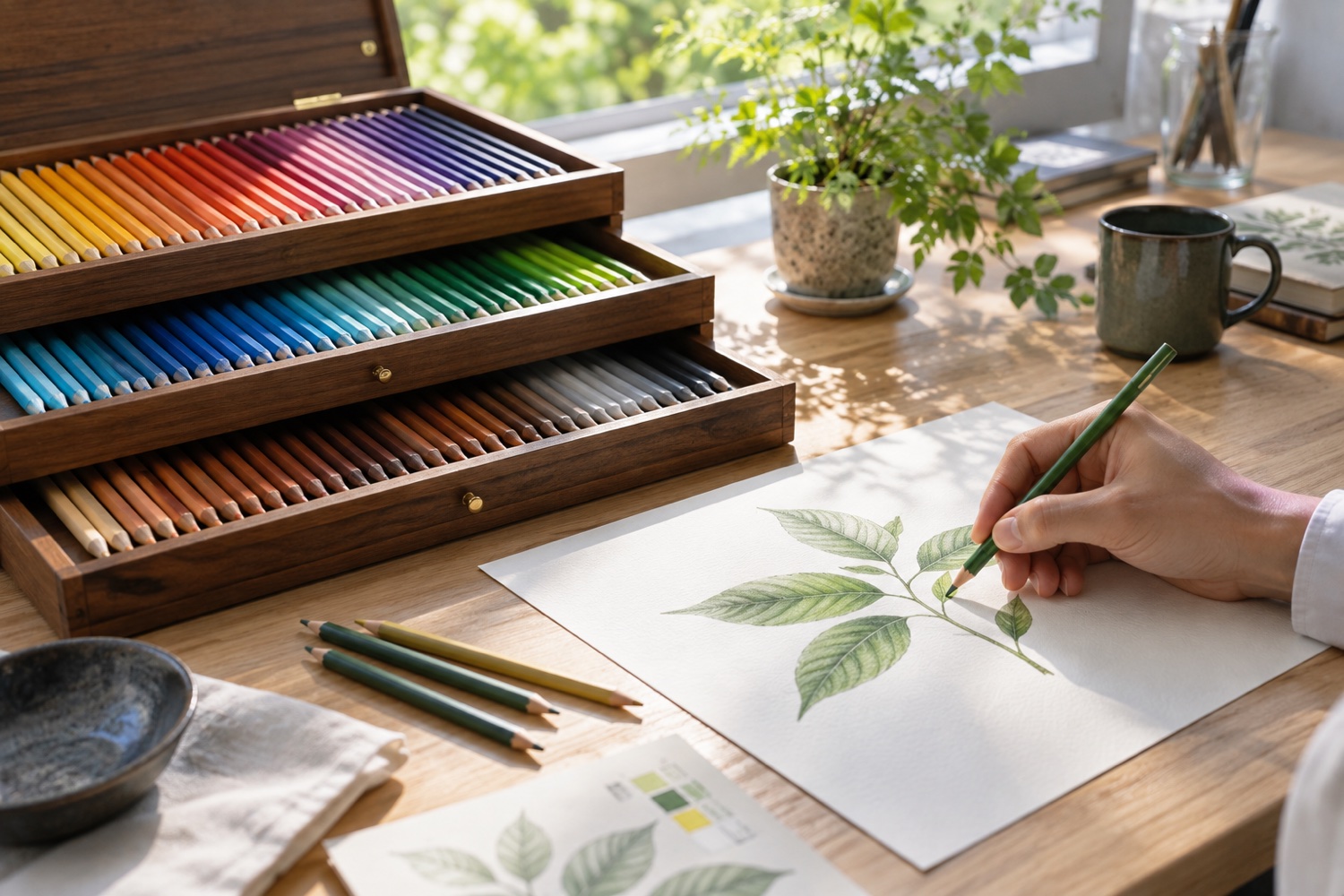
Colored pencils, not paint. For anything under an hour and away from a table, pencils win on setup alone: no water, no palette, no drying. Holbein’s 24-color set (OP920) is the size worth carrying — Holbein lists it in a tin, with a soft 3.8mm core in a 7.8mm barrel, and says three to four colors layer cleanly (Holbein, in Japanese). Neither Holbein nor the shop publishes the tin’s dimensions, so if it has to fit a particular pouch, ask before ordering. There’s a fuller look at that set, including what Japanese owners say about it, in colored pencils for an analog bag.
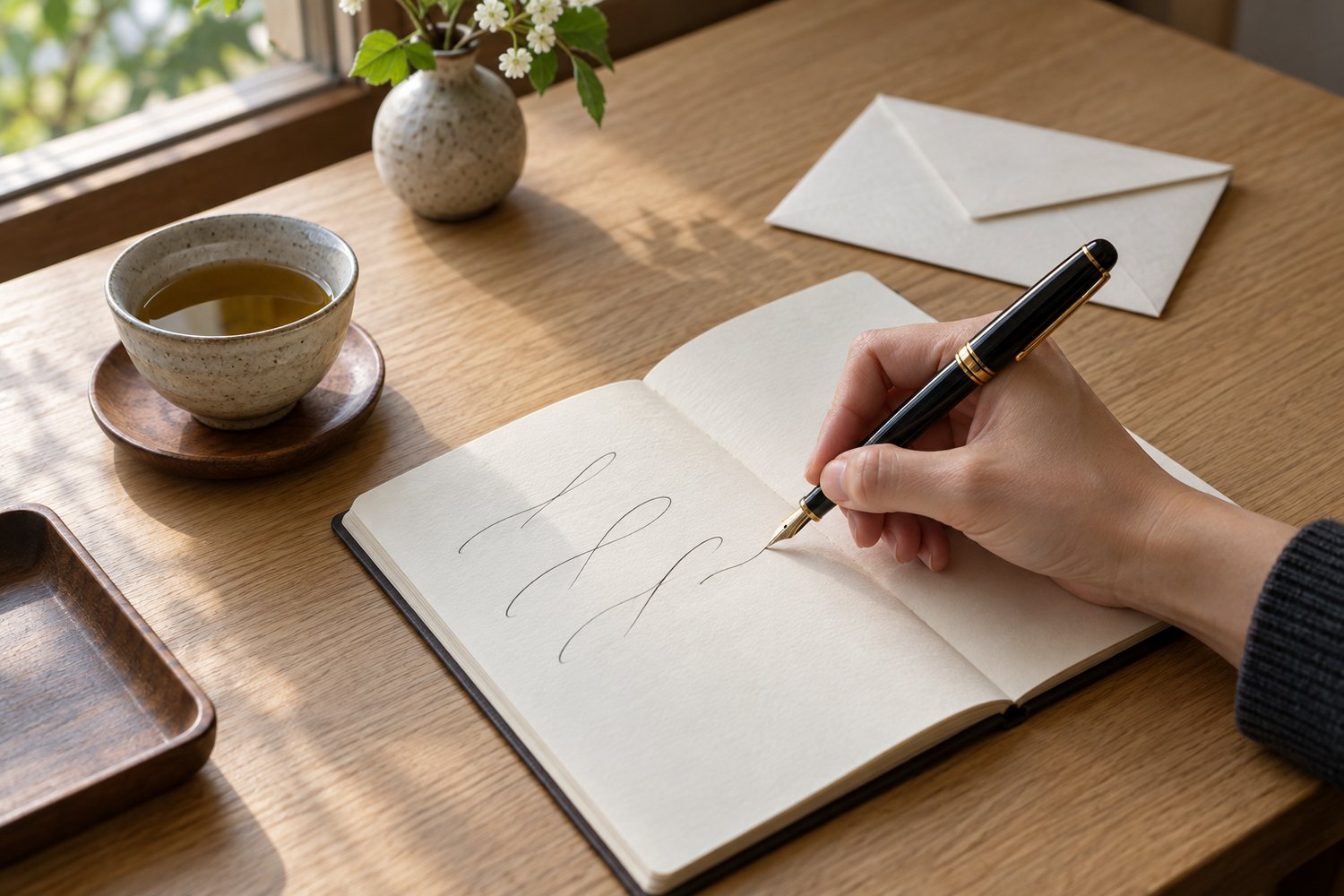
A pen you can open with one hand. Writing is the lightest “make” there is, and a fountain pen is the one people actually look forward to using. The catch in a bag is the cap: two hands, and somewhere to put it. Pilot’s Capless — sold as the Vanishing Point in North America — is a fountain pen with a retractable nib and a clicker, so it works the way a ballpoint does. Pilot lists the current matte black FC-18SR with an 18K nib, a brass body, 140mm and 30g. It’s the expensive item on this page, and it’s the one that changes a five-minute gap into something you’ll use. More on it in is the Pilot Capless a good gift?
The things that make the difference, and cost nothing
- Paper you like. A pencil set without a notebook is half a gift, and cheap paper is the fastest way to stop drawing.
- A pocket sharpener. Soft pencils need one. This is the single most common gap.
- A pouch inside the bag, so the pencils aren’t loose against a water bottle. Broken leads happen at the bottom of totes.
- Somewhere for the phone to go. Not a lecture — just an inside pocket rather than your hand, so taking it out is a decision.
If you’re giving this as a gift
Fill one slot, well. A complete kit assembled by someone else tends to sit unopened; a single good thing gets used, and the person can build the rest around it.
- Ask what’s in the bag now. Duplicating something they like is worse than giving nothing.
- Give the thing they wouldn’t buy themselves — better pencils, a proper pen — and pair it with the boring necessity: paper, a sharpener, a spare ink cartridge.
- Don’t frame it as a fix. A gift that arrives as a comment on someone’s screen time isn’t a gift.
- Check the size claims. Where a maker doesn’t publish dimensions, nobody can tell you it fits their bag.
Ordering from Japan
Okurimono Japan doesn’t sell anything. “Check Price” takes you to the product page at Discovery Japan Mall, an independent Japanese retailer; you order, pay and arrange any return there, on its terms. If you buy through a link here, we may earn a commission at no extra cost to you.
Prices and stock were checked on 16 September 2026 and change: the F-84W-1QJH at ¥2,736, the Holbein 24-color set at ¥7,018 and the Capless FC-18SR at ¥27,849, all before shipping and any duties. The shop says duties and taxes aren’t included and are collected on delivery (Customs Duties); what changed for US buyers is in ordering from Japan to the US. Returns are for damaged, defective or incorrect items reported within 7 days. More on all of it is on How to Buy.
One more thing
An analog bag isn’t a system, and it doesn’t need to be a hobby. It’s a bag with something good in it, so that when ten minutes appear, there’s a second option. The test isn’t what’s in the photo. It’s whether you picked it up again today.
Sources
Checked 16 September 2026.
- Marie Claire, “What’s an Analog Bag and Is It an Antidote to Doomscrolling?”, by Emma Childs, 28 January 2026: the origin of the term, what one bag contained, and the search interest.
- Michaels 2026 Creativity Trend Report, March 2026: rising searches on its own site for offline hobbies.
- Casio Japan, F-84W-1QJH: size, weight, battery life, functions and accuracy.
- Holbein, Artists’ Colored Pencils: oil-based pencils, core and barrel diameter, layering, and the 24-color set in a tin.
- Pilot’s product catalogue for the Capless FC-18SR: nib, body, length and weight.
- Discovery Japan Mall product listings: prices and stock.
Frequently asked questions
- What is an analog bag?
- A small bag of offline things to do, carried so there's something to reach for in a spare moment. Marie Claire traces the term to the content creator Sierra Campbell, who swapped scrolling for knitting, watercolor, Polaroids, crosswords and letter-writing, and carried a tote that made those things as reachable as a phone in her pocket. It isn't a product you buy; people assemble their own.
- What should go in one?
- Start with how long your gaps actually are, not with a shopping list. Five-minute gaps suit something you can open and close instantly; a long train ride suits something you can sink into. Two well-chosen things get used more than six that make the bag heavy.
- Why put a watch in an analog bag?
- Because checking the time is the most common reason a phone comes out, and once it's out it usually stays out. A cheap watch removes that trigger. Casio's F-84W-1QJH, for example, is listed at 21g and 8.5mm thick, so it adds almost nothing to the bag.
- How heavy is too heavy?
- There's no rule, but the bag you actually carry every day is the one that works. If you're leaving it at home because of the weight, take something out rather than buying a bigger bag.
- Are colored pencils better than paint for a bag?
- For short sessions away from a table, yes: no water, no palette, no drying time. Paint is better at home. If you want both, carry pencils and keep the paint on your desk.
- Is this about cutting screen time?
- Not here. This page treats an analog bag as a way to have something enjoyable with you, not as a treatment for anything. One person quoted by Marie Claire says her own screen time dropped; that's her experience, not a claim about anyone else.
- What's the best thing to give someone building one?
- One slot, filled well — not a complete kit. Ask what's already in the bag first, then give the thing they'd never buy for themselves, plus whatever it needs to work: paper, a sharpener, ink.