Fine or Medium? Choosing a Japanese Fountain Pen Nib for a Gift
 By Kotaro·Updated Sep 13, 2026·9 min read
This guide contains affiliate links: if you buy through one, the shop may pay me a small commission at no extra cost to you. How I choose and how I earn
You've chosen the pen and the color, and now the shop asks: EF, F or M? What those letters mean, why they aren't a standard across brands, how to decide from the way the person writes, and two Japanese pens you can order in either Fine or Medium, with the makers' own specifications.
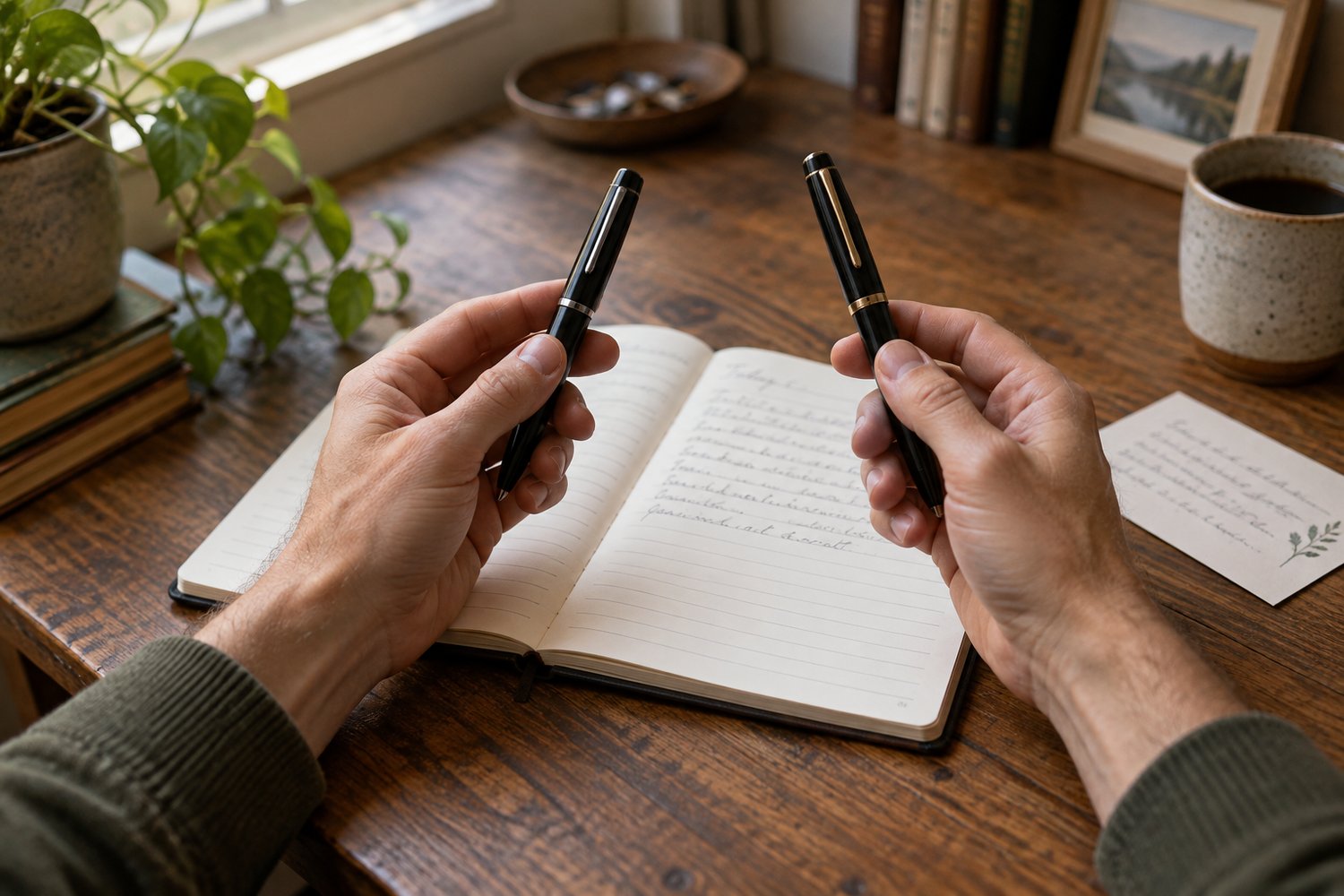
You’ve done the hard part. You picked the pen, maybe a color that suits them. Then the shop page asks one more question: EF, F or M? And suddenly the gift depends on something you can’t see.
This page is for that moment. It explains what the letters mean, why they aren’t the same from brand to brand, and how to guess well from the way the person writes. It then shows two Japanese pens you can order in either Fine or Medium. I’m a designer in Japan, not a pen reviewer. I haven’t tested these pens against each other, and there are no writing samples here. What follows is what the makers and a specialist retailer say, and what the shop lists.
If you’re still choosing the pen itself, start with a first fountain pen from Japan or is the Pilot Capless a good gift?
What EF, F and M mean
The letters are nib sizes, from thinner to thicker lines:
- EF (Extra Fine). The thinnest of the three.
- F (Fine). A thin line.
- M (Medium). A fuller line.
Some makers add sizes in between or around them. Pilot’s Custom series, for example, also offers FM (fine-medium), soft versions such as SF and SFM that flex a little more, and broader and specialty nibs (Pilot, Custom series nibs, in Japanese).
The letters aren’t a standard. There’s no industry-wide width for “Fine”. Goulet Pens, a US fountain pen retailer, compares it to clothing sizes: each company has its own, and it can differ between models from the same brand. It also notes that Japanese Extra Fine and Fine nibs tend to run about a full size finer than Western ones, which it links to the fine lines Japanese characters need (Goulet Pens, Japanese vs Western nibs). Platinum says it hand-finishes each nib tip to suit Japanese writing (Platinum, how a fountain pen works, in Japanese).
So compare sizes within one brand, and treat cross-brand comparisons as rough.
Start from how they write
None of these questions decides the nib by itself. Together, they point one way or the other.
- Do they write small? Tight notes in a notebook margin or a planner favor a finer nib.
- Do they keep a diary? Pilot lists diaries among the uses for both its Fine and its fine-medium nibs, so this one comes down to handwriting size.
- Do they write cards and letters? Larger, looser handwriting on good paper suits a fuller line. Pilot describes its Medium as for letters and slightly larger writing.
- What paper do they use? Goulet Pens notes that paper and ink both affect line width, so the same nib can look different in their notebook than on a card.
- What pen do they use now? If they love a fine gel pen, a Fine fountain pen will feel more familiar. If they reach for a bold ballpoint, Medium may.
- Do you know any fountain pen they already like? Its brand and nib size is the best clue you’ll get. Stay close to it within the same brand.
Pilot’s own advice, for anyone choosing, is to try a nib in a shop if you can (Pilot, nib FAQ, in Japanese). For a gift ordered from Japan, the questions above are the next best thing.
When Fine is the better choice
Pilot’s descriptions of its own nibs are a useful guide here (Pilot, Custom series nibs).
- Small handwriting and notes. Pilot describes its Fine as suited to a wide range of uses: notes, diaries, letters and résumés.
- A first fountain pen. Pilot recommends Fine for first-time users, because people new to fountain pens tend to press on the nib.
- Planners and tight spaces. If they write in a pocket diary or fill in small boxes, consider Extra Fine. Pilot describes it as for writing small characters, such as in a planner.
Things to know: a Japanese Fine may look finer than a Western Fine they’ve tried, and a thinner line shows less of an ink’s color.
When Medium is the better choice
- Larger handwriting, cards and letters. Pilot describes its Medium as for letters and people who write slightly larger.
- Someone who wants the line to show. A fuller line puts down more ink, so it can show more of an ink’s color.
- A signature or a card now and then. For signing and addressing envelopes, Pilot points to its broader nibs. Medium is a middle ground if the pen will also be used for everyday writing.
Things to know: more ink on the page can take longer to dry, which matters for a left-handed writer whose hand moves across fresh writing. And on thin or absorbent paper, a fuller line can spread more.
What else changes the line
Two people with the same pen and the same nib can get different lines. Brand and model set the nib, then several things shift the result.
- The brand and model. Sizes vary by brand, and sometimes by model within a brand.
- Soft or firm. Pilot’s soft nibs (SF, SFM, SM) flex a little, so the line changes with pressure. Pilot says they suit people who write with a light hand.
- The paper. Paper affects how much a line spreads, as Goulet Pens notes.
- The ink. Ink affects line width too, per the same source.
- Pressure and angle. How hard someone presses, and how they hold the pen, both show up in the line.
This page doesn’t give line widths in millimeters. The makers’ pages checked here describe nibs by name and use, not by a measured width. Numbers you see elsewhere are usually one person’s measurement with one ink on one paper.
Two Japanese pens, in Fine or Medium
Both are Japanese brands, and for each the shop lists the same model and color in Fine and in Medium, so the choice here is about the nib, not the pen. Prices are Discovery Japan Mall’s in yen on 13 September 2026, before shipping, and all were listed as in stock. Specifications are from the makers’ catalogues.
For quick notes: Pilot Capless Decimo
Who it suits. Someone who writes in short bursts: meeting notes, a shopping list, a quick line in a planner. A click extends the nib; a second click retracts it behind a shutter.
Nib options. Pilot’s catalogue lists the Decimo in EF, F and M in every color. The shop lists the Dark Blue Mica in both F and M, which makes the choice easy to compare.
Why this one. Pilot describes the Decimo as a lightweight, slim click-action fountain pen, the tenth Capless model since 1963. Its shutter seals the retracted nib to prevent leaks and drying (Pilot web catalogue, Capless Decimo, in Japanese).
Pilot’s specifications. 18K gold nib; click action; painted aluminum barrel; 139.5mm (5.5 in) long, 12mm across; 21g (0.7 oz). Compatible converter per Pilot: CON-40. The shop’s listing names CON-20 and CON-50 instead, so check with the shop before buying a converter.
Grip and shape. On a Capless, the clip sits at the nib end, where some people’s fingers rest. See the Capless gift guide for how to check. The Capless is sold as the Vanishing Point in North America; this page covers the Japanese FCT-15SR model and doesn’t assume a North American Decimo has the same specifications.
In the box. Not itemized by Pilot or the shop. Buy cartridges alongside.
For cards and letters, written now and then: Platinum #3776 Century “Nice” Rosé
Who it suits. Someone who writes cards and letters occasionally and may leave the pen capped for weeks. Platinum’s slip-seal cap is designed to keep ink from drying out.
Nib options. Platinum lists the “Nice” in F, M and B (Platinum, #3776 Century Nice, in Japanese). The shop lists the Rosé in F and in M.
Why this one. The shop’s listing describes the slip-seal cap as airtight, keeping the pen ready to write even after two years unused with the cap on. That’s the shop’s claim, and it’s the reason to consider this pen for an occasional writer. The frosted, cut body is what makes it a gift.
Platinum’s specifications. Large 14K gold nib, pink-gold plated on the Rosé; AS resin body with a frosted cut finish; 139.5mm (5.5 in) long, 15.4mm across at the widest; 19.6g (0.7 oz). Platinum lists a Converter-700A and a blue-black ink cartridge as included, and a presentation box.
Other nib options: soft nibs
Some pens come in more than Fine and Medium. Pilot’s Custom 74, for example, is made with 11 nibs, including soft versions such as SF (soft fine) and SFM (soft fine-medium) that flex a little with pressure (Pilot, Custom series nibs, in Japanese). A soft nib isn’t a substitute for a Medium. It’s a different feel, which Pilot says suits people who write with a light hand. Consider one only if you know the person wants it; for the Custom 74 as a pen, see a first fountain pen from Japan.
If you don’t know their preference
- Look at the pen they use most. A fine gel pen points to F; a bold ballpoint points to M.
- Look at their handwriting. A card or a list they’ve written tells you whether they write small or large.
- Ask sideways. “Do you like thin lines or bold ones?” is an ordinary question to ask while looking at pens together.
- Ask someone who knows. A partner or friend may know which pen they always borrow.
- When in doubt, stay near the middle of the brand’s range: F or M, not EF or B.
Don’t plan on exchanging the nib afterwards. The shop’s returns policy covers damaged, defective or incorrect items, not a nib size that turned out not to suit.
Will it write on the day you give it?
Check what comes with the pen:
- Platinum #3776 Century “Nice”. Platinum lists a converter and a blue-black cartridge as included.
- Pilot Capless Decimo. Neither Pilot’s catalogue nor the shop’s listing says what’s in the box. Pilot cartridges are sold separately, so add a pack to the order, or ask the shop.
If you add ink, choose the maker’s own cartridges for that pen. Don’t describe a pen and a separate pack of ink as a “set” in the card unless the shop sells them that way.
How to buy from Japan
Okurimono Japan doesn’t sell anything. “Check Price” takes you to the product page on Discovery Japan Mall, an independent Japanese retailer (not Pilot’s or Platinum’s own shop). You buy and pay there, and the shop handles shipping, returns and support.
- Duties and taxes. The shop’s Customs Duties page says they aren’t included and are collected on delivery.
- Returns. The shop’s Returns & Exchanges page accepts returns only for damaged, defective or incorrect items reported within 7 days of delivery, with photos.
- Box and wrapping. The pens ship in the maker’s packaging; the shop’s listings don’t itemize it, except that Platinum lists a presentation box for the “Nice”. Gift wrapping isn’t listed as a service.
More on ordering from Japan is on How to Buy; more pens are in the Stationery category.
One more thing
The nib is the part of the pen that touches their handwriting. You won’t get it perfect from a distance, and you don’t need to. Choose the line that fits how they already write, and the pen has a good chance of becoming the one they reach for when they want to write something down properly.
Sources
Checked 13 September 2026.
- Pilot, Custom series nibs (Japanese): nib types, uses, the recommendation of Fine for first-time users, and which Custom models offer which nibs.
- Pilot, nib FAQ (Japanese): the advice to try nibs in a shop.
- Pilot web catalogue, Capless Decimo (Japanese): specifications, nib options and converter.
- Platinum, #3776 Century “Nice” (Japanese): nib options, specifications and included items; how a fountain pen works (Japanese).
- Goulet Pens, Japanese vs Western fountain pen nibs (2017): no common sizing standard; Japanese fine nibs running finer; paper and ink affecting line width.
- Discovery Japan Mall product listings: nib sizes offered, prices, stock, and the shop’s descriptions.
Frequently asked questions
- What do EF, F and M mean on a fountain pen?
- They're nib sizes: Extra Fine, Fine and Medium, from the thinnest line to a thicker one. Pilot describes its EF as a firm extra-fine for small writing such as in a planner, F as a firm fine suited to notes, diaries and letters, and M as a firm medium for letters and slightly larger writing.
- Is a Fine nib the same width at every brand?
- No. There's no common standard. Goulet Pens, a US pen retailer, notes that each company has its own sizing, and that it can even differ between models within a brand. Treat the letters as a guide within one brand, not a measurement.
- Do Japanese nibs run finer than Western ones?
- Often, especially at the fine end. Goulet Pens says Japanese Extra Fine and Fine nibs tend to be about a full size finer than Western ones, and links this to the fine lines Japanese characters need. It's a tendency, not a rule, so a Japanese Medium isn't guaranteed to match a particular Western Fine.
- Should a first-time fountain pen user get Fine or Medium?
- There's no single right answer. Pilot's own nib guide recommends Fine for first-time users, because beginners tend to press on the nib. Others prefer Medium for a fuller line. Start from the person's handwriting and the paper they use.
- Can I exchange the nib if I choose wrong?
- Don't assume so. Discovery Japan Mall, the shop linked here, accepts returns only for damaged, defective or incorrect items reported within 7 days of delivery. Choosing a nib size that turns out not to suit isn't a defect. Ask the shop before ordering if you're unsure.
- Will the pen write straight out of the box?
- It depends on what's included. Platinum lists a converter and a blue-black ink cartridge with the #3776 Century 'Nice'. Pilot's catalogue lists a compatible converter for the Capless Decimo but doesn't itemize what's in the box, and the shop's listings don't either. Buy ink cartridges alongside, or ask the shop.
- Does a finer nib stop ink from bleeding on thin paper?
- Not reliably. Goulet Pens notes that ink and paper both affect line width, and how much a line spreads depends on the paper as well as the nib. A finer nib puts down a thinner line, but it isn't a guarantee on every paper.