A Japanese Watch for a Graduation or First Job: How to Choose
 By Kotaro·Updated Sep 17, 2026·7 min read
This guide contains affiliate links: if you buy through one, the shop may pay me a small commission at no extra cost to you. How I choose and how I earn
How to choose a Japanese watch as a graduation or first-job gift by the recipient's life, not the brand ladder: Seiko Riki, Seiko Presage Cocktail Time and Casio Oceanus compared by size, movement, upkeep and who each suits, with official specs and what to confirm with the shop.
Choose a graduation or first-job watch by three things about the person, not by brand: how they dress, what size their wrist and cuff can take, and whether they want a watch to look after or one that looks after itself. For most new graduates that points to a simple 34–40mm three-hand watch. The four Japanese watches below cover the realistic range: a $90 quartz Seiko Riki, two Seiko Presage automatics, and a Casio Oceanus solar radio watch — with official specifications and what to confirm before ordering.
This guide is about choosing, not about which is “best”. I’m a designer in Japan and I haven’t worn these particular references; the specifications come from Seiko’s and Casio’s official product pages, and the prices and stock from the shop this site links to. If you are interested in why some Seiko and Casio models are only sold in Japan, that is covered in the Japan-only watches guide; this page doesn’t repeat it.
Who this is for
- A graduate starting a first office job. They need a watch that works under a shirt cuff and doesn’t look like a toy or a statement.
- A graduate going into a trade, a lab or a hospital. Durability, water resistance and a watch that sets itself matter more than a dress look.
- A graduate who has never owned a “real” watch. The gift is also the habit; a watch that asks little of them is more likely to be worn.
- Parents, grandparents, godparents, a mentor. The occasions here are a degree, a first job, a bar or medical exam passed, a first paycheck.
The three questions that choose the watch
1. How will they dress? A leather strap and a small case go under a cuff and with a jacket. A titanium bracelet reads as more technical and suits a jacket-less office, a lab coat or scrubs. A dial with a GMT hand suits someone who will travel for work.
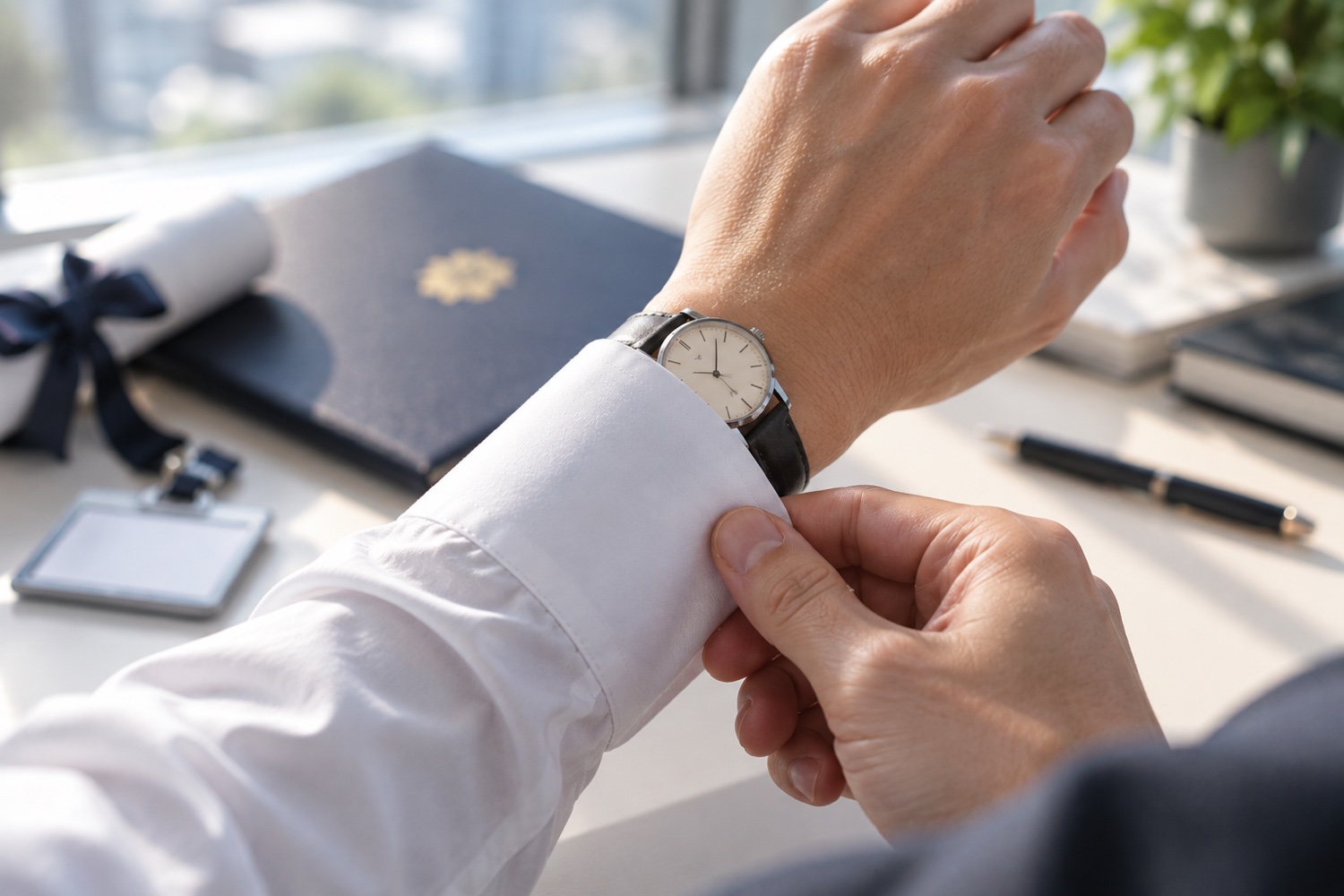
2. What size wrist and cuff? Diameter is the obvious number; thickness is the one people forget. A 10–11mm case slides under a shirt sleeve; a 12–13mm case sits on top of it. On a 15–17cm wrist, 34–38mm looks proportionate; on 17–19cm, 38–42mm.
3. Do they want a watch to care for or a watch that cares for itself? An automatic is wound by wearing it and stops after a day or two off the wrist; it then needs setting. Some people love that ritual. Others want a watch that is always right. Quartz and solar are for the second group.
Four watches, compared
Specifications are from Seiko’s and Casio’s official Japanese product pages, with one exception: Seiko has since taken down its product page for the Riki AKPK437, so its case size and weight now come from retailer listings, and its battery life (about 3 years) from Seiko’s instruction manual for the VX51 caliber. Prices are the shop’s at the time of writing, converted approximately. All four are in stock at Discovery Japan Mall at the time of writing.
| Seiko Riki AKPK437 | Seiko Presage Cocktail Time SRRY052 | Seiko Presage Cocktail Time GMT SARY243 | Casio Oceanus OCW-S100B-1AJF | |
|---|---|---|---|---|
| Suits | A first watch; slim wrists; anyone who likes Japanese color | An office job; a small, elegant bracelet watch | A job with travel; someone who wants a mechanical watch | A lab, hospital or trade; someone who never wants to set a watch |
| Movement | Quartz (Cal. VX51), battery about 3 years | Automatic with hand-winding (Cal. 4R35), about 41 hours reserve | Automatic with hand-winding (Cal. 4R34), about 41 hours reserve, 24-hour GMT hand | Solar quartz, radio-controlled (Multiband 6: Japan, N. America, Europe, China) |
| Case | 36.0mm, 6.9mm thick, stainless steel with pink-gold color plating | 34.0mm wide, 10.7mm thick, stainless steel | 40.5mm wide, 12.8mm thick, stainless steel | 41.5mm wide, 10.5mm thick, titanium |
| Weight | 39g | 87g | 67g | 90g |
| Strap | Calf leather (kasane-iro two-tone) | Stainless steel bracelet | Leather, three-fold clasp | Titanium bracelet, three-fold clasp |
| Glass | Curved inorganic glass | Box-shaped Hardlex | Box-shaped Hardlex | Sapphire (dual-curve) |
| Water resistance | Everyday (splash) | 5 bar | 5 bar | 10 bar |
| Upkeep | Battery change every few years | Wear or wind; set after it stops | Wear or wind; set after it stops | Charge in light; sets itself where a signal exists |
| Approx. price | ¥12,890 (about $90) | ¥85,800 (about $585) | ¥80,300 (about $545) | ¥80,176 (about $545) |
| Confirm with shop | Included box; strap length | Bracelet sizing; box | Strap length; box | Signal coverage in their country; box |
For a first watch: Seiko Riki AKPK437
Designed after the work of Riki Watanabe, a Japanese industrial designer, and sold under Seiko’s Alba brand in Japan. It is a 36mm quartz watch, 6.9mm thick and 39g, with a calf strap in a traditional Japanese two-color pairing (the “kasane-iro” series). It asks nothing of the wearer except a battery every three years or so. It is the right gift when the person has never worn a watch, when their wrist is slim, or when the budget is under $100 and you want the gift to still look chosen.
For the office: Seiko Presage Cocktail Time 34mm SRRY052
The smaller Cocktail Time: 34mm wide, 10.7mm thick, on a stainless bracelet, with Seiko’s 4R35 automatic movement (hand-winding, about 41 hours of reserve). Seiko describes the dial as inspired by a frozen cocktail, with a crushed-ice texture and diamond markers at the quarters. It suits someone starting an office job who wants a watch that is clearly a watch, sits under a cuff, and is a small pleasure to wind on Monday morning. The bracelet will need sizing locally.
For a job with travel: Seiko Presage Cocktail Time GMT SARY243
The 40.5mm Cocktail Time with a 24-hour GMT hand, so it can show a second time zone. The 4R34 automatic movement has hand-winding and about 41 hours of reserve; the case is 12.8mm thick, which is the one thing to weigh against a tight shirt cuff. Leather strap, 5 bar water resistance, 67g. It suits a graduate whose first job involves other time zones, or someone who has told you they want a mechanical watch.
For someone who never wants to set a watch: Casio Oceanus OCW-S100B-1AJF
A titanium three-hand watch that charges from light and sets itself by radio signal where a signal exists (Casio lists Japan, North America, Europe and China for this Multiband 6 model). 41.5mm wide but only 10.5mm thick, 90g on its titanium bracelet, sapphire glass, 10 bar water resistance. It was released in 2013 — a long-running model rather than a fashion piece. It suits a graduate going into a lab, a hospital, a workshop or any job where a watch is a tool.
What to ask before you buy
- Leather or bracelet? Decides between the Riki/GMT and the 34mm Cocktail Time/Oceanus.
- Small or visible? 34–36mm or 40–42mm.
- Ritual or convenience? Automatic (the two Presage) or quartz/solar (Riki, Oceanus).
- Wrist size. If you can’t ask, look at their current watch or bracelet.
- Where they live. For the Oceanus, whether Casio’s Multiband 6 covers that country.
Before you buy
- Sizing. Bracelet models ship unsized; a local watch shop removes links. Leather straps adjust with the buckle — check the maximum length for larger wrists (Seiko lists 195mm for the GMT).
- Setting. The automatics stop after about 41 hours off the wrist and need setting, including the date; the Oceanus sets itself only where a signal exists, otherwise by hand.
- Box. Seiko and Casio watches ship in the maker’s box, but the shop’s product pages don’t describe the box or any papers. Confirm with the shop if it matters.
- Gift wrapping. Not listed as a standard service by the shop. Ask, or wrap it yourself.
- Warranty. Handled in Japan; the shop states you pay round-trip shipping and duties for warranty service.
- Not for: someone who has said they don’t wear watches. A Japanese fountain pen is the other classic graduation gift.
How to buy from Japan
Okurimono Japan doesn’t sell anything. “Check Price” takes you to the product page on Discovery Japan Mall, an independent Japanese retailer (not Seiko’s or Casio’s own shop) that ships internationally and shows prices in your currency. You pay them directly by card or PayPal. The shop states orders usually ship within 5 business days with tracking and insurance; customs duties, where charged, are collected on delivery. Returns are accepted only for damaged, defective or incorrect items reported within 7 days with photos. Prices on this page are approximate conversions at the time of writing; the live price is on the shop. Full details on How to Buy.
Frequently asked questions
- What is the safest Japanese watch to give for a graduation or first job?
- A simple three-hand watch in a mid size, 34–40mm, that matches how the person will actually dress and live. For most people that means the Seiko Riki (36mm, quartz, under $100) or a Seiko Presage Cocktail Time (34mm or 40.5mm, automatic). Choose the Casio Oceanus only if they want a titanium bracelet watch that sets itself.
- Quartz, automatic or solar — which is better for a first watch?
- None is better; they ask different things of the owner. Quartz needs a battery change every few years and nothing else. An automatic needs to be worn or wound and set when it stops. Solar radio-controlled watches charge from light and set themselves where a time signal is available. Match the type to whether the person wants a watch that is a hobby or a watch that is a tool.
- How do I know what size fits their wrist?
- Look at what they wear now. A 34–36mm case suits slim wrists and looks right under a shirt cuff; 40–42mm reads as a larger, more visible watch. Case thickness matters as much as diameter for cuffs: under 11mm slides under a sleeve, 12–13mm does not always. If you can measure their wrist, 15–17cm circumference suits 34–38mm; 17–19cm suits 38–42mm.
- Will a radio-controlled Casio set itself outside Japan?
- Only where a supported time signal exists. Casio lists the Oceanus models here as Multiband 6, covering Japan, North America, Europe and China. Elsewhere the watch keeps time as a normal solar quartz watch and is set by hand; the Manta can also sync via Bluetooth to a phone. Check the coverage for the country the person lives in.
- Are these watches Japan-only?
- The exact reference numbers here (ending in J or JF) are Japan-market versions. Equivalent models may or may not be sold abroad under different references, and availability changes. This guide doesn't claim they are unobtainable elsewhere, only that these versions ship from Japan with Japanese-market specifications.
- Does the warranty work outside Japan?
- Not reliably. Seiko and Casio warranties are generally handled in the country of purchase, and the shop states that the customer pays round-trip shipping and customs for warranty service in Japan. Treat the watch as one you would have serviced by a local watchmaker.
- Can the bracelet be sized before shipping?
- The shop's product pages do not offer bracelet sizing. Leather-strap models (Riki, Cocktail Time GMT) adjust with the buckle. Bracelet models (Cocktail Time 34mm, both Oceanus) will need links removed by a local watch shop, which is usually a small charge; the Oceanus Manta has a slide-adjust clasp for fine adjustment.
- What should I ask the person before buying?
- Three things, casually: whether they prefer leather or a metal bracelet; whether they like a small, discreet watch or a larger one; and whether they would enjoy winding and setting a mechanical watch or would rather never think about it. Those answers choose between the four watches below.