From Germany to Japan's Diplomatic Tables: The Story of Kagami Crystal
 By Kotaro·Updated Sep 13, 2026·7 min read
This guide contains affiliate links: if you buy through one, the shop may pay me a small commission at no extra cost to you. How I choose and how I earn
In 1927 a Japanese ceramics engineer went to Germany to learn to engrave crystal. Kozo Kagami came home, opened a studio, then a crystal factory, and his company went on to supply glassware for Japan's missions abroad. A short history from Kagami's own records and an independent obituary, the difference between engraving and kiriko cutting, and two Kagami pieces you can give today.
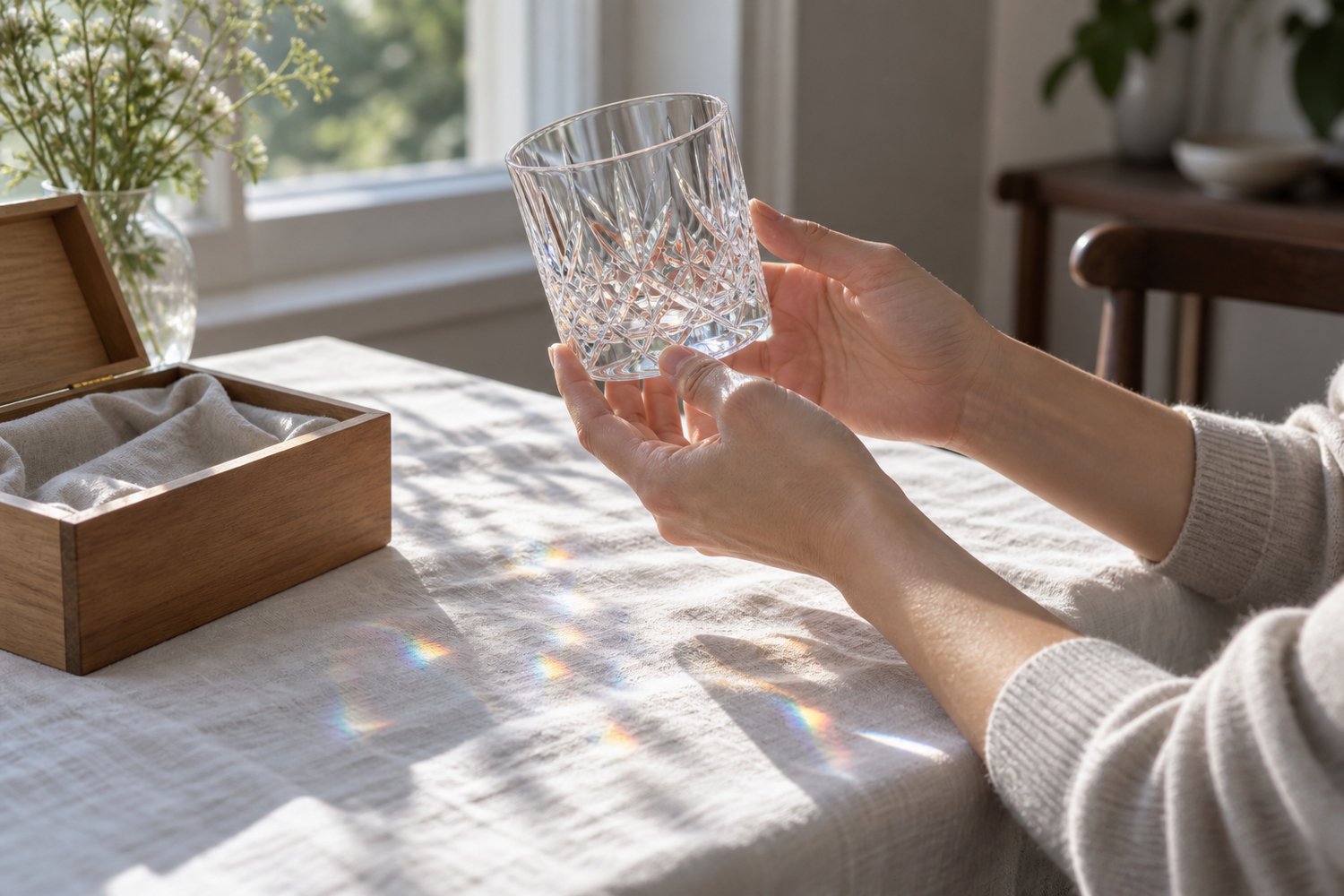
If you’ve been given a Kagami glass, it probably came in a wooden box, and it probably looked like something you’d see at an official dinner. That’s not an accident of marketing. The company’s history does run through Japan’s diplomatic tables. But it starts with one person going abroad to learn a skill, and bringing it home.
This is a short history of Kagami Crystal, drawn mainly from the company’s own records and an independent obituary published by Japan’s national research institute for cultural properties. Where Kagami’s English and Japanese pages disagree, this page says so. At the end are two Kagami pieces you can give today.
A ceramics engineer who wanted to work with glass
Kozo Kagami was born in 1896 in Toki District, Gifu Prefecture. He studied at the Aichi Prefectural Ceramics School, then design at the Tokyo Higher Technical School, graduating in 1916 (Tokyo National Research Institute for Cultural Properties, obituary, in Japanese).
By the 1920s he was working in Manchuria for the South Manchuria Railway, in its ceramics research institute, according to Kagami’s English history page and the independent obituary (Kagami, History). Kagami’s Japanese history page words his affiliation differently, naming a glass subsidiary of the railway, so the exact organisation is described two ways (Kagami, 沿革, in Japanese).
Stuttgart, 1927
In 1927 he went to Germany to study crystal. Kagami’s history says the purpose was to learn crystal processing, “especially copper-wheel engraving”. The obituary adds that the railway sent him, and that he studied gravure and cutting for about a year and a half at the state school of arts and crafts in Stuttgart, under its principal, Professor Wilhelm von Eiff, before returning in 1929.
His graduation piece, a plate titled Prayer (1929), is mentioned by Kagami as having been praised by von Eiff.
Copper-wheel engraving is hard to learn. You carve the design into the glass using a spinning copper wheel fed with fine abrasive, and Kagami’s staff page notes that the engraver can’t look directly at the surface being carved. Kagami describes the technique as developed in Bohemia and says it was introduced to Japan by Kozo Kagami (Kagami, Crystal). That’s the company’s own claim, and a reasonable one to repeat as such.
A studio in 1930, a factory in 1934
Back in Japan, Kagami set up his own studio. In 1930 the Kagami Crystal Glass Institute opened in Takinogawa, Tokyo, and began creative work in cutting and engraving (Kagami, History).
In 1934 he founded a factory in Kamata, Tokyo. Kagami describes it as Japan’s first factory with an integrated production system specialising in crystal glass. Read plainly, “integrated” suggests one site that could take crystal from raw glass through to finished cut and engraved pieces; the company doesn’t define the word, so treat that as a reading rather than a quote. The company dates its founding to June 1934.
Recognition followed. Kagami’s history lists a medal of honour at the 1937 Paris International Exposition and an honour award at the 1939 New York World’s Fair. It doesn’t say what was shown in New York, and neither does this page.
Glassware for Japan abroad
After the war, Japan re-established its missions overseas, and they needed to be furnished. Kagami’s Japanese history says that in 1952, as overseas missions reopened, the company began supplying crystal tableware to the Ministry of Foreign Affairs as fixtures for those missions. The English version says the glassware was for use in Japanese embassies and consulates overseas (Kagami, History).
The link continued. Kagami’s history records new stemware lines for official banquets at overseas missions in 1997 and 2008. It also records glassware for the Imperial Palace in 1968, tableware for official receptions at the State Guest House, Akasaka in 1974, and banquet crystal for the Prime Minister’s official residence in 2002. Kagami lists the Imperial Household Agency, the Ministry of Foreign Affairs, the State Guest House and the Prime Minister’s residence among its customers for official-reception tableware (Kagami, Company).
One note: Kagami’s English timeline describes a 1990 entry as glassware for the state funeral of Emperor Showa, while the Japanese timeline describes the 1990 entry as tableware for the Emperor’s enthronement banquet. The Japanese wording is the one to rely on.
So when a Kagami glass arrives in a wooden box and looks like it belongs at a formal table, there’s a history behind that impression. That doesn’t make any particular glass you buy the same item used at an embassy, and this page doesn’t claim it is.
Engraving and cutting: two ways to decorate crystal
Kagami works in two main decorative techniques, and it helps to know the difference when you choose a piece (Kagami, Crystal).
- Gravure (engraving). A design sketched on the glass is carved with a copper wheel and fine abrasive, then polished and given soft gradations. Kagami says it produces soft shading that cutting can’t.
- Cutting (kiriko). Geometric patterns are ground into the glass with grinding wheels, built from a small set of basic cuts. Kagami calls cutting the most important processing technique for crystal. Where coloured glass is layered over clear glass (overlay, or kise), the cut reveals the clear glass beneath.
Edo Kiriko, the Tokyo cut-glass tradition, belongs to the second group. Kagami makes contemporary Edo Kiriko based on traditional patterns; its Japanese page says this work is done by its own cutters with the cooperation of certified traditional craftspeople (Kagami, Edo Kiriko, in Japanese). For the tradition itself, see What is Edo Kiriko?
Today, Kagami’s factory is in Ryugasaki, Ibaraki, where the company moved from Tokyo in 1990. In 2024 it opened the KAGAMI Memorial Museum at the factory.
Two Kagami pieces to give
For a mother or father who loves glass, modern design or the story behind a maker — the kind of person who looks up the artist after seeing a piece in a museum — a Kagami piece comes with this history attached. Here are two: one for someone who enjoys a drink, one for someone who doesn’t.
Specifications are from Kagami’s product pages; prices are Discovery Japan Mall’s in yen on 13 September 2026, before shipping, and both were listed as in stock.
Rock glass “Kikuhana”, T727-2685-CMP
Who it suits. A parent who enjoys whisky or a drink over ice, and who’d appreciate knowing who cut their glass.
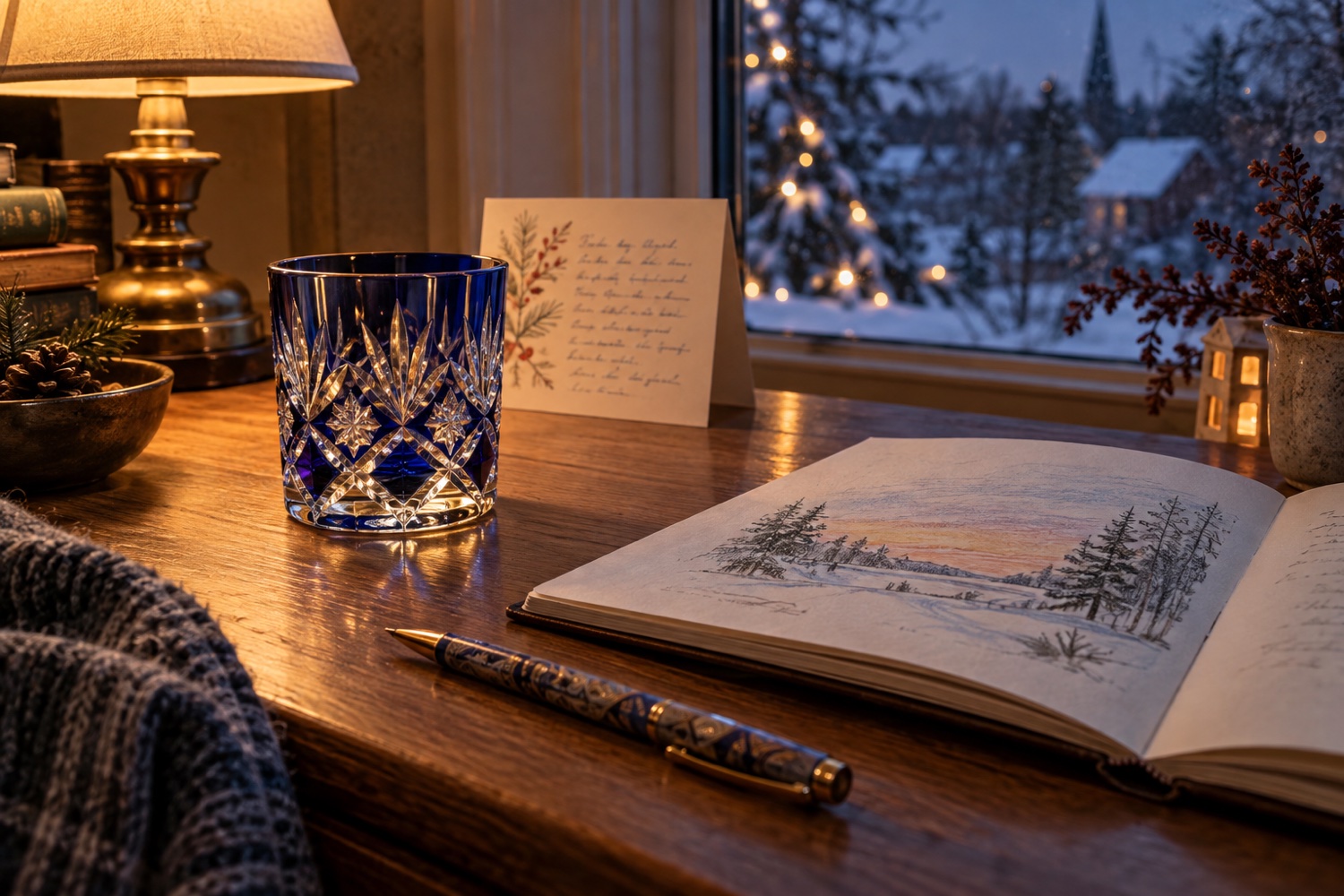
Why this one. Kagami says this Edo Kiriko rock glass was designed and cut by certified traditional craftsman Satoshi Nabeya. Its simple chrysanthemum cuts reflect one another like a kaleidoscope, and looking down into the glass shows a finely cut chrysanthemum pattern on the base (Kagami, T727-2685-CMP).
Kagami’s specifications. Crystal; mouth 74mm, height 87mm, 240ml; wooden box.
Know before you buy. Kagami’s care guidance: hand-wash, no dishwasher or microwave, and avoid sudden temperature changes. Handmade pieces can go out of stock.
Small bowl “Take no Zen” (bamboo), green, M347-1908-CGR
Who it suits. A parent who doesn’t drink, or who’d use a piece of crystal every day on the table — for sweets, a small side dish, or keys by the door.
Why this one. Kagami describes it as a small Edo Kiriko bowl inspired by fresh green bamboo, with bright green overlay crystal and simple cuts (Kagami, M347-1908-CGR).
Kagami’s specifications. Green overlay crystal; diameter 125mm, height 42mm; wooden box.
Know before you buy. Same care as above. The colour and cut can look slightly different from photos, as with any handmade piece.
For more cut-glass gifts by occasion, see Edo Kiriko gifts by occasion.
How to buy from Japan
Okurimono Japan doesn’t sell anything. “Check Price” takes you to the product page on Discovery Japan Mall, an independent Japanese retailer (not Kagami’s own shop). You buy and pay there, and the shop handles shipping, returns and support.
- Price. Prices above are the shop’s in yen on 13 September 2026, before shipping and any duties. Shipping is added at checkout.
- Box vs. gift wrap. Both pieces come in Kagami’s wooden box. Gift wrapping is separate and isn’t listed by the shop.
- Timing. The shop notes that items ordered from the maker can take 3 to 5 days to dispatch; delivery then depends on the carrier and customs.
- Duties and taxes. The shop’s Customs Duties page says they aren’t included and are collected on delivery.
- Returns. The shop’s Returns & Exchanges page accepts returns only for damaged, defective or incorrect items reported within 7 days of delivery, with photos. Open glass as soon as it arrives.
More on ordering from Japan is on How to Buy; more in the Japanese Crafts category.
Sources
Checked 13 September 2026.
- Kagami Crystal, History (English) and 沿革 (Japanese): 1927 Germany, 1930 institute, 1934 factory, 1937 and 1939 awards, 1952 supply to overseas missions, later banquet lines, 1990 move to Ibaraki.
- Tokyo National Research Institute for Cultural Properties, obituary of Kozo Kagami (Japanese, from the 1986 Japan Art Yearbook): birth and death, schooling, Stuttgart, return in 1929.
- Kagami Crystal, Company: founding date, customers, location.
- Kagami Crystal, Crystal: gravure, cutting and overlay.
- Kagami Crystal, Edo Kiriko (Japanese).
- Kagami Crystal product pages for T727-2685-CMP and M347-1908-CGR (Japanese).
Frequently asked questions
- Who founded Kagami Crystal?
- Kozo Kagami (1896–1985). He trained in ceramics and design in Japan, studied crystal engraving and cutting in Stuttgart, Germany, from 1927, set up his own studio in Tokyo in 1930, and founded a crystal factory in 1934.
- Does Kagami make glassware for Japanese embassies?
- Kagami's history says that from 1952 it began supplying crystal tableware to the Ministry of Foreign Affairs for Japan's embassies and consulates overseas, and that it later developed stemware for official banquets at overseas missions. The pieces in this guide are Kagami products you can buy; this guide doesn't claim they are the same items used at any embassy.
- What's the difference between gravure and kiriko?
- Gravure is engraving: Kagami describes carving a design into the glass with a copper wheel and fine abrasive, producing soft shading. Kiriko is cut glass: geometric patterns ground with grinding wheels. Kagami does both.
- Is Kagami the same as Edo Kiriko?
- No. Edo Kiriko is a traditional cut-glass craft associated with Tokyo. Kagami is a crystal maker that produces Edo Kiriko among other things, including engraved and cut crystal of its own designs.
- Where is Kagami made today?
- Kagami's head office and factory are in Ryugasaki, Ibaraki Prefecture, where the company moved from Tokyo in 1990. It opened a memorial museum at the factory in 2024.