What Is Edo Kiriko? Japan's Cut Glass Craft, Explained
 By Kotaro·Updated Sep 13, 2026·6 min read
This guide contains affiliate links: if you buy through one, the shop may pay me a small commission at no extra cost to you. How I choose and how I earn
Edo Kiriko is Tokyo's traditional cut-glass craft, dated to 1834. Its history, the traditional patterns and what they're named after, how a piece is cut, how it differs from Satsuma Kiriko, and what to look for when you buy, from the Edo Kiriko Cooperative and Kagami Crystal.
Edo Kiriko (江戸切子) is Tokyo’s traditional cut-glass craft. The Edo Kiriko Cooperative dates it to 1834, when Kagaya Kyubei, a glass merchant in Edo’s Odenmacho, is said to have engraved the surface of glass using emery. Craftspeople cut geometric patterns into clear glass or through a thin colored layer, and each pattern has a traditional name. Tokyo designated Edo Kiriko a traditional craft in 1985, and the national government followed in 2002 (Edo Kiriko Cooperative).
I’m a designer living in Japan, and Edo Kiriko was the first craft I wrote about on this site, because it puts pattern so literally into your hand.
Note: photographs on this page are illustrative images of the craft. Product photos in each card come from the shop’s own listing.
A short history
In 1834, the cooperative says, Kagaya Kyubei, who ran a glass shop in Odenmacho in Edo, near today’s Nihonbashi in Tokyo, engraved the surface of glass with emery. Kagami Crystal describes Edo Kiriko as growing up in the city’s merchant culture and being handed down by cutters without a break for more than 180 years (Kagami, Edo Kiriko, in Japanese).
The craft took its modern form in the Meiji era. In 1873 a glassworks opened in Shinagawa. In 1881 it invited an English cutting instructor, Emanuel Hauptmann, and more than ten Japanese craftsmen trained under him. The cooperative says this established the traditional techniques passed down in Edo Kiriko today. From the Taisho era into the early Showa era, new glass materials and crystal-polishing methods improved quality further.
Two designations matter. In 1985 Tokyo designated Edo Kiriko a traditional craft of the metropolis. In 2002 the national government designated it a Traditional Craft of Japan.
One maker you’ll see often is Kagami Crystal, founded in 1934. Kagami describes its factory as Japan’s first with an integrated production system specializing in crystal glass. It makes Edo Kiriko with its own cutters and the cooperation of certified traditional craftspeople. For its story, see From Germany to Japan’s diplomatic tables.
The patterns, and what they’re named after
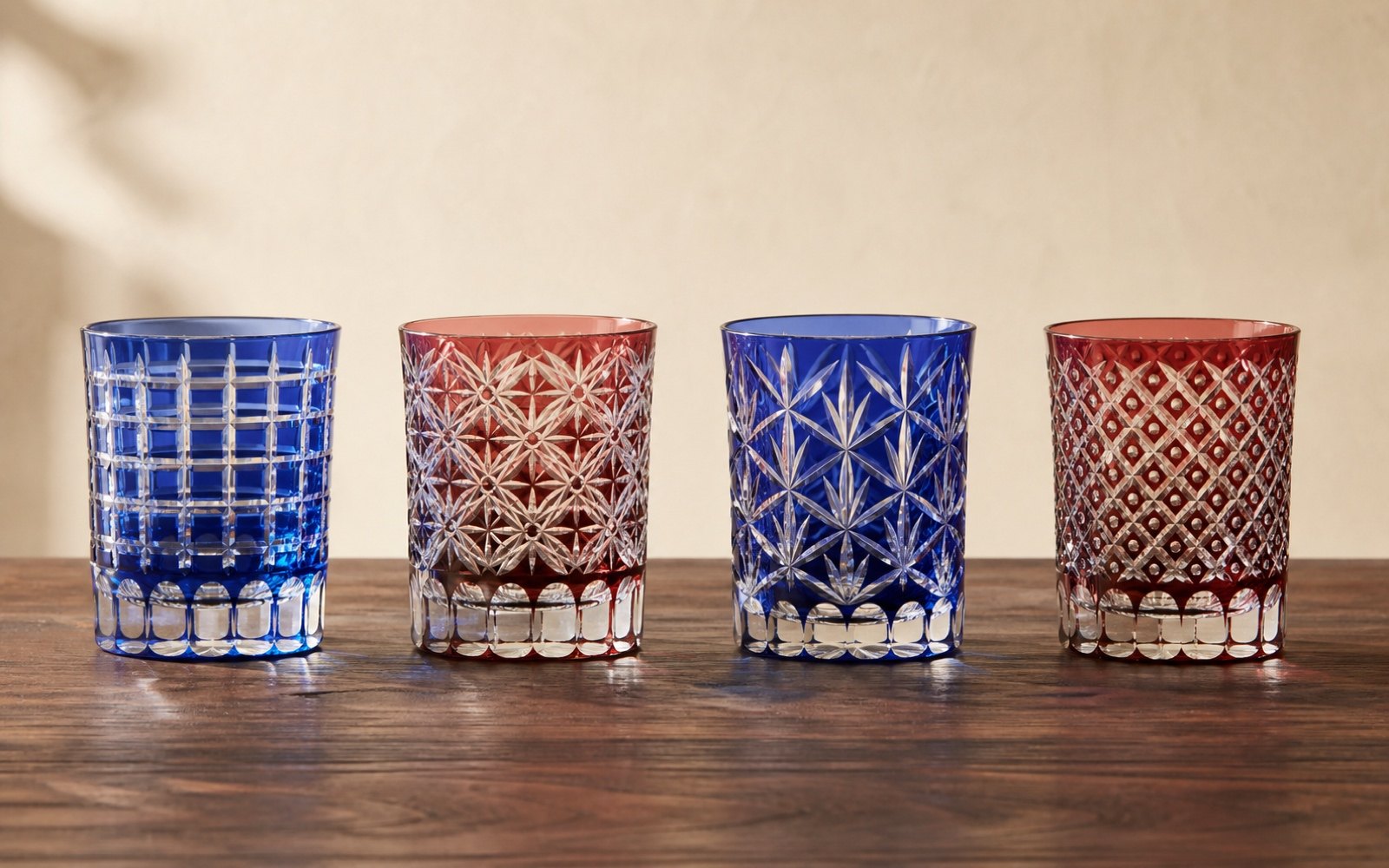
The cooperative lists more than a dozen typical Edo Kiriko patterns. Kagami explains where several of the names come from. Some patterns also carry traditional good-luck associations. Kiriko Kobo Shinko, an Edo Kiriko studio, explains these on its pattern guide (Shinko, Edo Kiriko patterns, in Japanese).
| Pattern | Japanese | Named after (Kagami) | Traditional association (Shinko) |
|---|---|---|---|
| Yarai | 矢来 | A rough fence of bamboo or logs | Protection from bad luck |
| Kiku-tsunagi | 菊繋ぎ | A chain of chrysanthemum blooms | Long life and good health |
| Asa-no-ha | 麻の葉 | The shape of a hemp leaf | A wish for children to grow up healthy, since hemp grows fast |
| Hakkaku-kagome | 八角籠目 | The octagonal weave of a bamboo basket | Warding off bad luck |
| Nanako | 魚子 | Fine reflections that look like rows of fish scales | — |
So the pattern can be part of the message, if you want it to be. A chrysanthemum pattern for a parent’s milestone birthday is an easy example. But these are traditional associations, not rules, and a piece chosen because the person will enjoy using it is a good gift either way.
How a piece is made
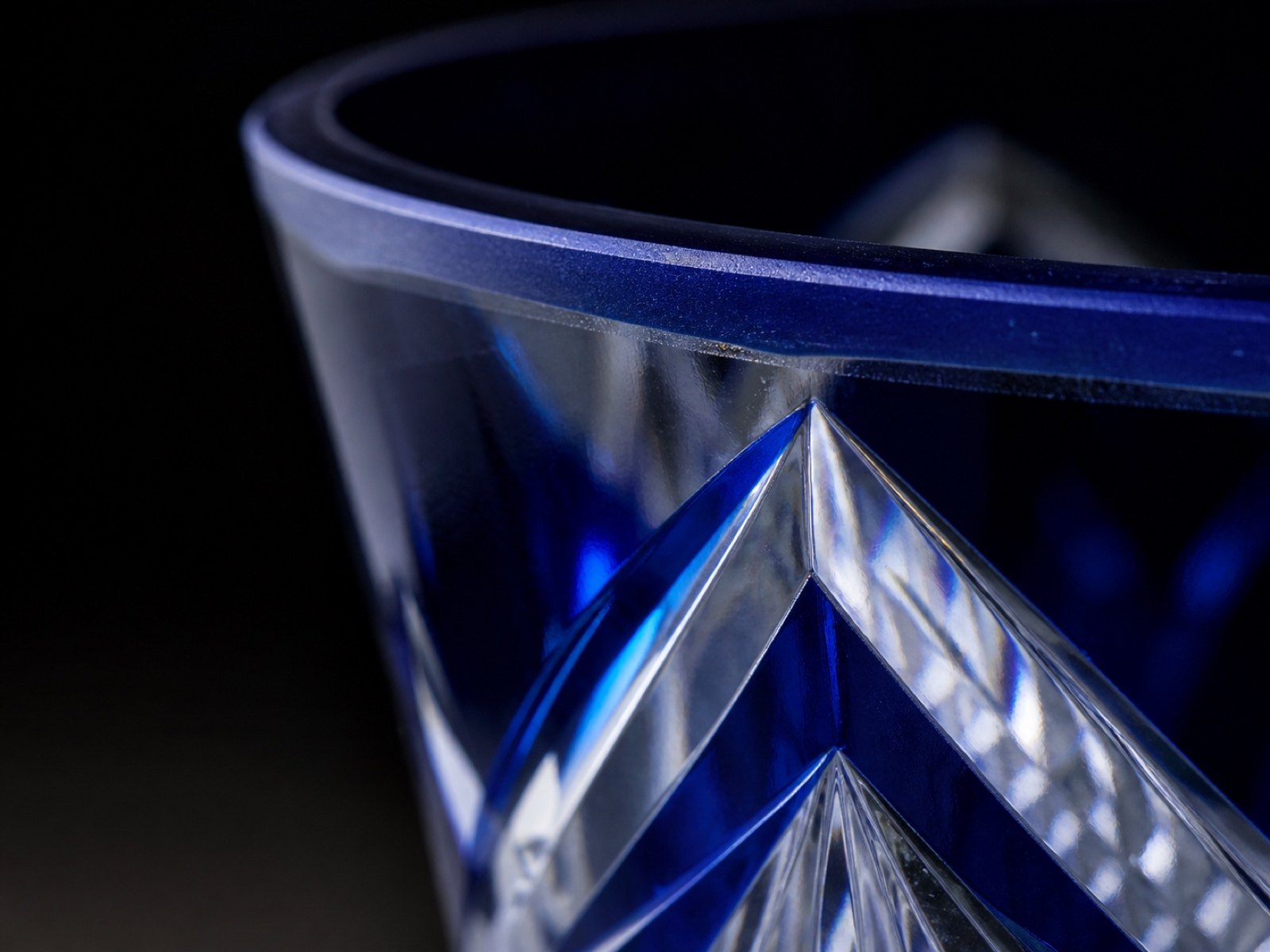
The color comes first. The cooperative explains that colored pieces are two-layer glass: a thin outer layer of colored glass over a thicker inner layer, usually clear, formed when the glass is made. The color isn’t painted on. Deep blue (ruri) comes from cobalt, deep red from copper and bright red from gold.
The cutting stages, as the cooperative lists them:
- Waridashi (割り出し). Vertical and horizontal marks are drawn as guides for the cuts.
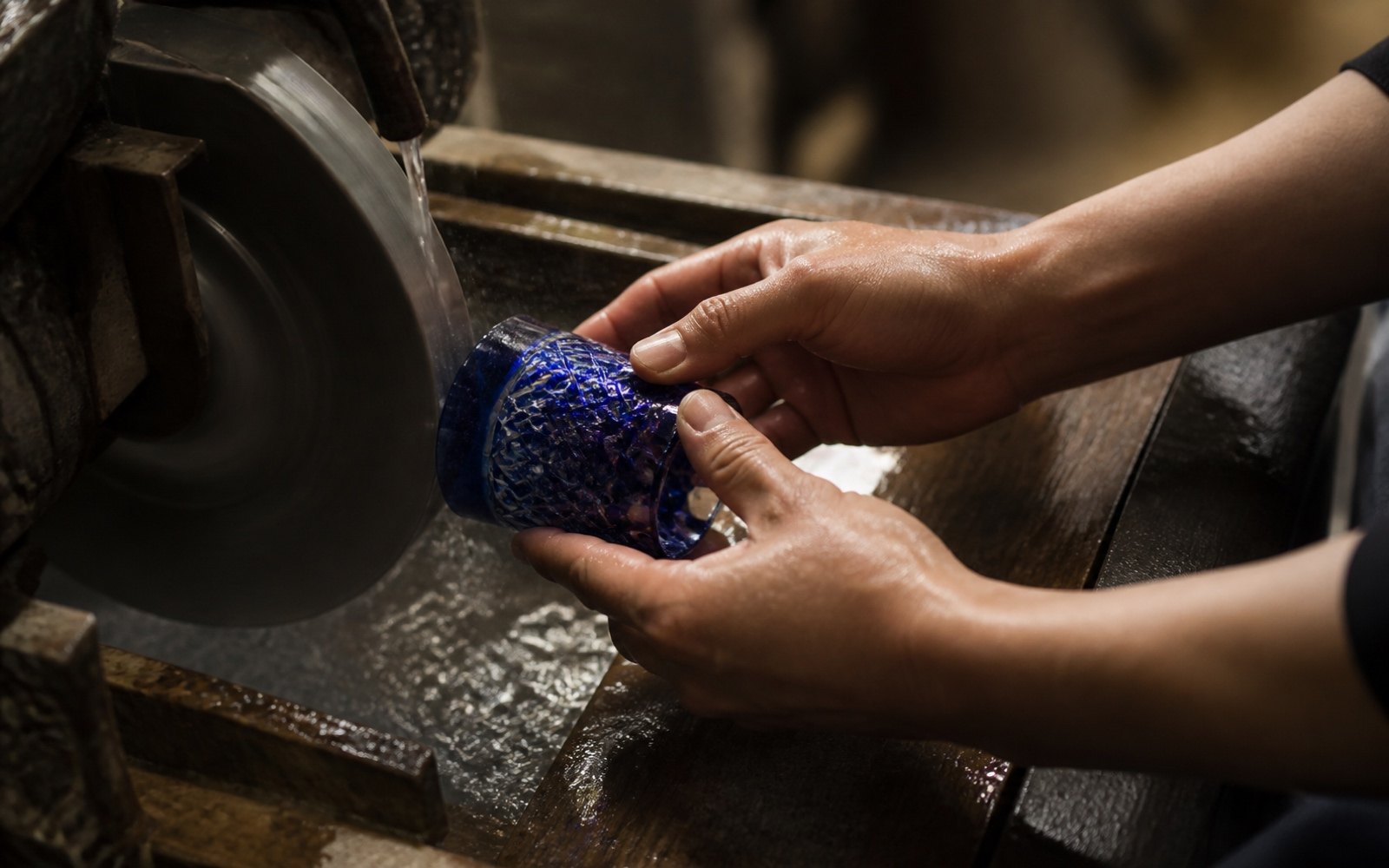
- Arazuri (粗摺り). A wet diamond wheel cuts the rough outline of the design.
- Sanban-gake (三番掛け). Finer, smoother cuts are made over the rough outline.
- Ishikake (石掛け). Artificial or natural stones smooth the cut surfaces, with water.
- Migaki (磨き). A wooden or resin wheel with abrasive brings out the shine. Some makers use acid polishing instead.
- Bafu-gake (バフ掛け). A felt or cotton wheel with cerium oxide gives the final polish.
The cooperative puts the number of Edo Kiriko craftspeople at just under 100 (as of 2025). About 20% are women, and among craftspeople in their twenties, the numbers of men and women are equal.
Edo Kiriko vs. Satsuma Kiriko
Japan’s two best-known cut-glass traditions are easy to tell apart once you know the key difference, which is the colored layer.
| Edo Kiriko (Tokyo) | Satsuma Kiriko (Kagoshima) | |
|---|---|---|
| Glass | Clear, or a thin colored layer | Mainly thick colored glass |
| Look of the cuts | Deep, sharp, precise | A soft color gradation (“bokashi”) where the color is cut |
| History | Since 1834, without a break | Began at the end of the Edo period, died out in early Meiji, revived in the late Showa era |
Source: the Edo Kiriko Cooperative’s Q&A.
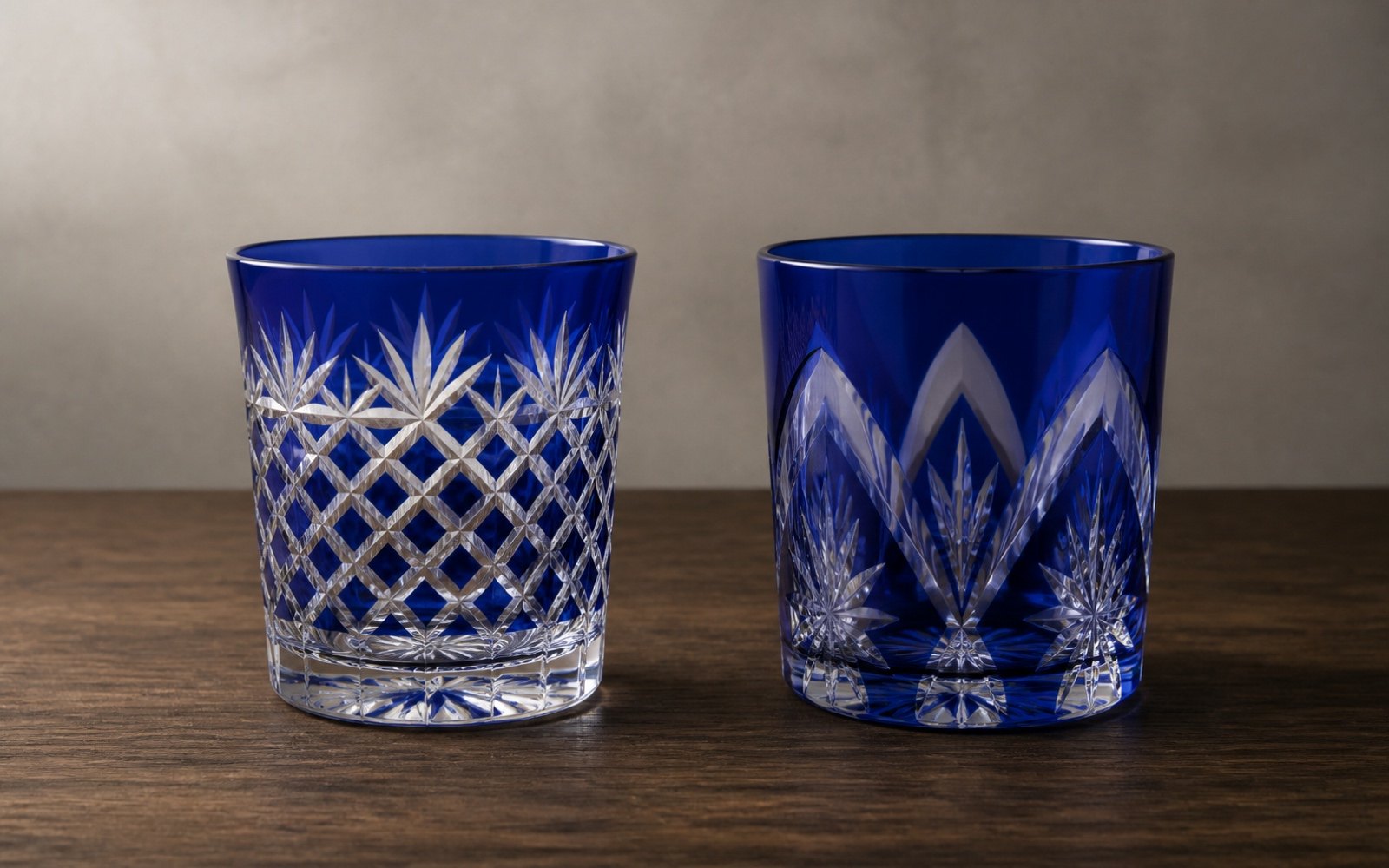
Neither is “better.” Edo Kiriko reads as crisp and rhythmical, Satsuma Kiriko as soft and painterly.
What to look for when you buy
- The name and the maker. “Edo Kiriko” is a registered regional trademark of the Edo Kiriko Cooperative. Buy from a named maker or studio, such as Kagami Crystal or a cooperative member, rather than an unnamed “kiriko-style” glass.
- The certificate label. The cooperative explains that Edo Kiriko carrying the national traditional-craft certificate label has passed its inspection. Not every genuine piece carries one, so treat it as a plus, not a requirement.
- Crystal or soda glass. Both are used. Crystal is heavier and clearer but scratches more easily. The listing should say which.
- The box. Both Kagami pieces below come in a wooden box, according to Kagami’s specifications and the shop’s listing. Keep it; it’s part of the presentation and useful for storage.
Two pieces to start with
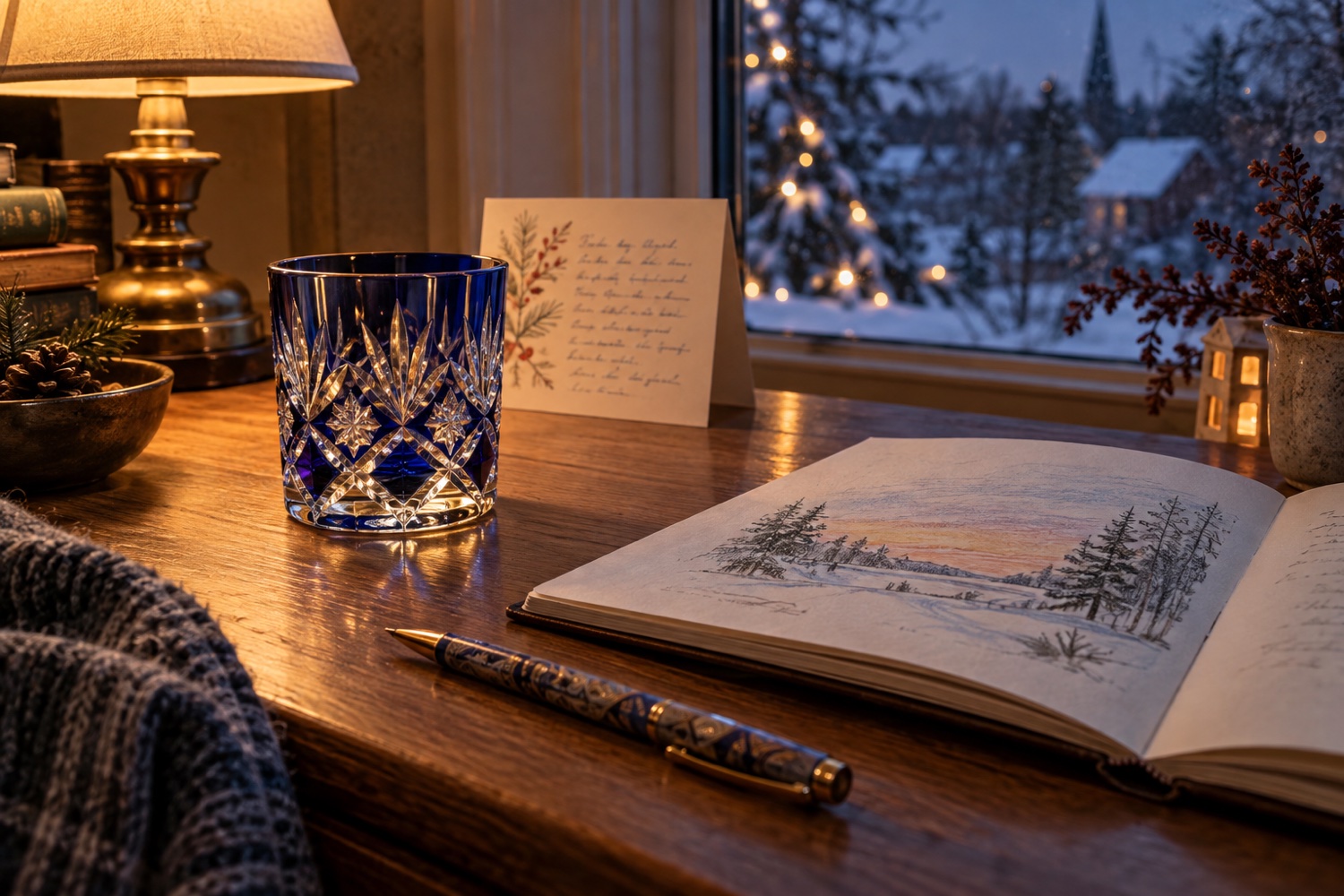
A rock glass is a classic first piece: substantial in the hand, and used every time you pour. This one is Kagami’s “Kikuhana” chrysanthemum rock glass. Kagami says it was designed and cut by certified traditional craftsman Satoshi Nabeya.
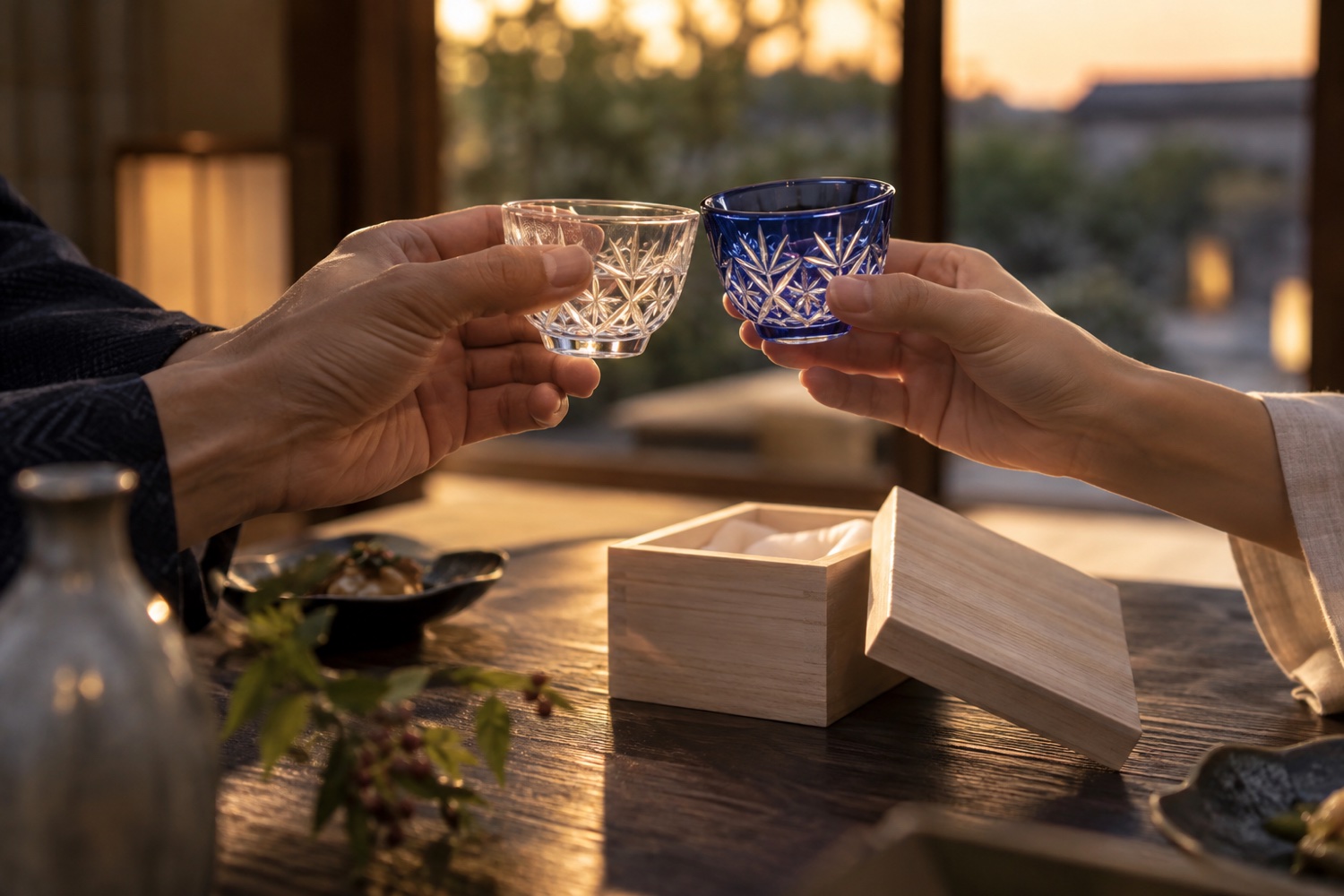
If you drink sake, or know someone who does, a guinomi (sake cup) is the other easy format. This one is cut in the yarai lattice.
Both are sold by Discovery Japan Mall and come in a wooden box. Prices are the shop’s in yen on 13 September 2026, before shipping, and both were listed as in stock. For more pieces, see the most beautiful Edo Kiriko glasses you can buy from Japan and Edo Kiriko gifts by occasion.
How to buy from Japan
Okurimono Japan doesn’t sell anything. “Check Price” takes you to the product page on Discovery Japan Mall, an independent Japanese retailer (not Kagami’s own shop). You buy and pay there, and the shop handles shipping, returns and support.
- Duties and taxes. The shop’s Customs Duties page says they aren’t included and are collected on delivery.
- Returns. The shop’s Returns & Exchanges page accepts returns only for damaged, defective or incorrect items reported within 7 days of delivery, with photos. Open glass as soon as it arrives.
More on ordering from Japan is on How to Buy.
Sources
Checked 13 September 2026.
- Edo Kiriko Cooperative, About Edo Kiriko and home page Q&A (Japanese): history, designations, patterns, process, certificate label, care, Satsuma Kiriko, soda and crystal glass, number of craftspeople.
- Kagami Crystal, Edo Kiriko (Japanese): pattern names, Kagami’s Edo Kiriko production.
- Kiriko Kobo Shinko, Edo Kiriko patterns (Japanese): traditional associations of the patterns.
Frequently asked questions
- How do you pronounce Edo Kiriko?
- Eh-doh kee-ree-koh. 'Edo' is the old name of Tokyo, and 'kiriko' means cut glass in Japanese.
- Is Edo Kiriko dishwasher safe?
- No. The Edo Kiriko Cooperative says not to use a microwave, dishwasher, dish dryer, oven or open flame, and to avoid sudden temperature changes and impacts. Wash by hand; the cooperative suggests something softer than glass, such as a soft brush, for dirt in the cuts.
- Why is Edo Kiriko expensive?
- The traditional-craft designation requires the main parts of the work to be done by hand, and each pattern is cut and polished in several stages. The cooperative puts the number of Edo Kiriko craftspeople at just under 100. Crystal glass, which some pieces use, also costs more than ordinary soda glass.
- What is the difference between Edo Kiriko and Satsuma Kiriko?
- According to the Edo Kiriko Cooperative, Edo Kiriko began in Edo (Tokyo) in 1834 and has continued without a break. It uses clear glass or glass with a thin colored layer, and its cuts are deep, sharp and precise. Satsuma Kiriko began in the Satsuma domain at the end of the Edo period and died out in the early Meiji era. Today's Satsuma Kiriko comes from revival production that began in the late Showa era. It is cut into thick colored glass, which gives a soft color gradation called bokashi.
- Is Edo Kiriko made of crystal?
- Not always. The cooperative describes both soda glass and crystal glass being used. Soda glass is light and strong. Crystal glass contains lead oxide, is clearer, refracts light more and is heavier, but scratches more easily. Check the listing for which one you're buying.
- How can I tell if a piece is authentic Edo Kiriko?
- 'Edo Kiriko' is a registered regional trademark of the Edo Kiriko Cooperative. Pieces carrying the national traditional-craft certificate label have passed the cooperative's inspection. Not every genuine piece carries that label, so also buy from a named maker or studio, such as Kagami Crystal or a cooperative member.
- Is Edo Kiriko a good gift?
- It's a well-known Japanese gift. Kagami Crystal's pieces in this guide come in a wooden box, which helps presentation. Some traditional patterns are also associated with good wishes, such as chrysanthemums with long life. Choose by how the person will use it: a rock glass for a whisky drinker, a sake cup for a sake drinker, a small bowl for someone who doesn't drink.