How Tobacco Knives Helped Build Sakai's Kitchen Knife Tradition
 By Kotaro·Updated Sep 26, 2026·7 min read
This guide contains affiliate links: if you buy through one, the shop may pay me a small commission at no extra cost to you. How I choose and how I earn
Sakai, the city south of Osaka, is known for the single-edged knives Japanese chefs use. Part of that story runs through tobacco: the knives made to shred its leaves in the late 16th century. A short history of Sakai knifemaking from municipal and craft-body sources — tobacco knives, the shogunate's Sakai Kiwame mark, and a town that splits each knife between specialists — and one Sakai-made yanagiba you can give today.
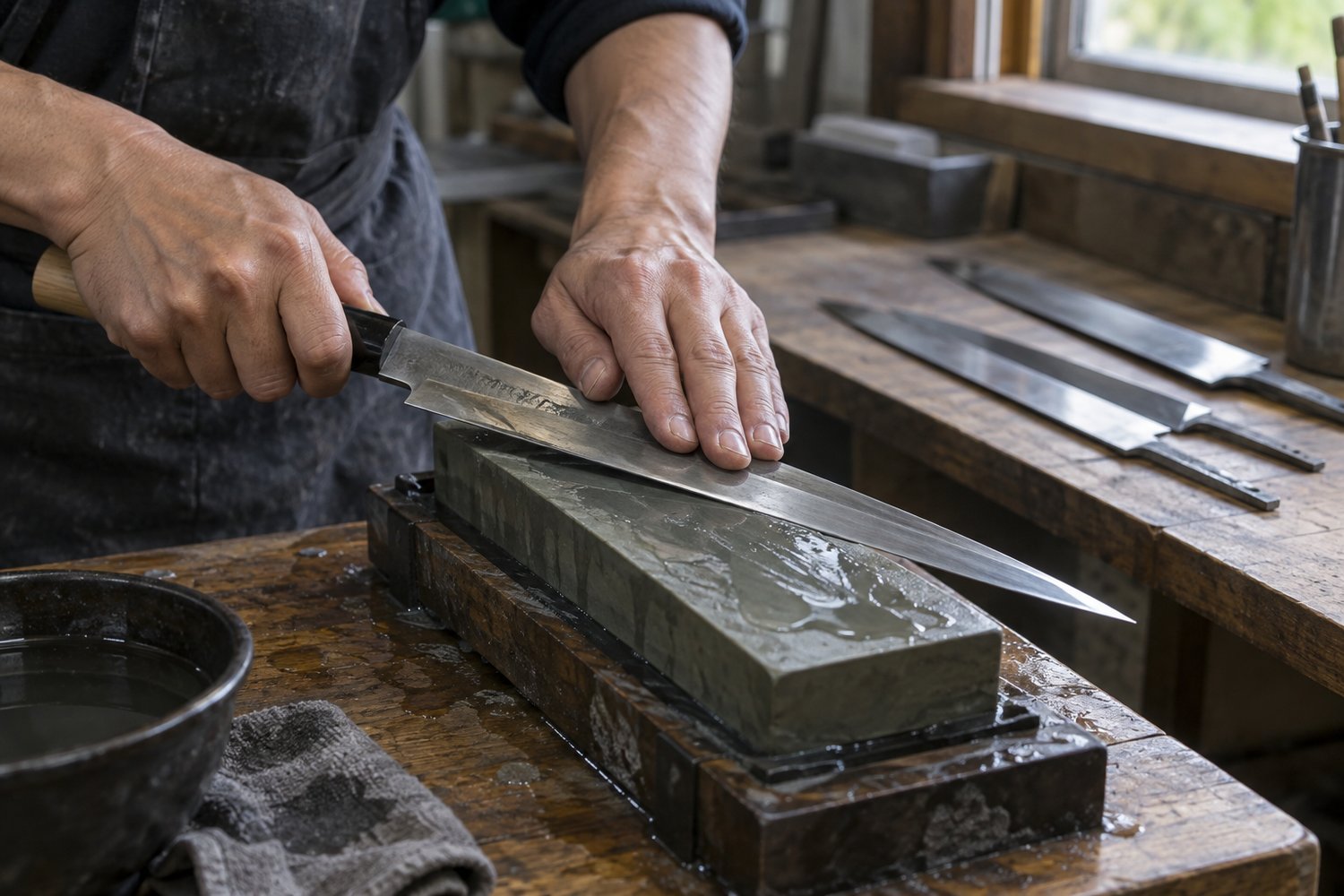
If you’ve ever bought a single-edged Japanese knife — the long, thin yanagiba chefs use for sashimi, or the heavy deba for breaking down fish — there’s a good chance the name Sakai appeared somewhere on the box.
Sakai is a city on Osaka Bay, and knives have been part of its identity for centuries. The usual shorthand is that Japanese kitchen knives descend from Japanese swords. Sakai’s own history is more interesting than that, and one of its turning points involves a plant rather than a blade: tobacco.
This page is a short history built on sources from Sakai City, the city’s tourism and traditional-craft bodies, and Japan’s national traditional crafts association. Where those sources hedge (“it is said”), this page does too. At the end is one Sakai-made knife you can give today.
Iron before knives
Sakai’s metalworking roots go back a long way, though the details are told as tradition rather than record. Sakai City and the Sakai Traditional Crafts Museum both say it is said that tools made for building the area’s great burial mounds in the 5th century laid a foundation for local iron-working (Sakai City, Cutlery; Sakai Traditional Crafts Museum, in Japanese).
Other local sources add different threads: smiths descended from sword-making traditions settling in the area, and casting skills from nearby foundry workers (Sakai Tourism and Convention Bureau; Sakai City Library, local history, in Japanese). None of them says simply that swords became kitchen knives. It’s a braid of several crafts.
Tobacco arrives, and Sakai makes the knives
In the second half of the 16th century, tobacco, brought by Portuguese traders, began to be grown in Japan. To use the leaves, they had to be shredded very finely, which called for a particular kind of knife. According to Sakai City, Sakai became the first area to make these tobacco knives (Sakai City, Cutlery).
Japan’s traditional crafts association dates tobacco knife-making in Sakai to the late 16th century (Association for the Promotion of Traditional Craft Industries, Sakai Uchihamono). The Sakai Traditional Crafts Museum describes Sakai’s tobacco knives as sharper than imported ones, and as the root of Sakai’s cutlery trade. The city library’s account is more careful, saying the origin is said to lie in tobacco knives and stone-cutting blades in that period.
The details matter less than the shape of the story. A new product created demand for a particular tool. Sakai’s smiths became known for making it well.
A mark worth copying
Success brought imitators. In the Edo period, the Tokugawa shogunate allowed Sakai’s tobacco knives to be sold under a special mark, Sakai Kiwame (堺極). Sources describe it slightly differently: a quality certification mark with a sales monopoly, according to the traditional crafts association; a government-designated brand, in Sakai City’s English page. The city library adds that the mark came in because counterfeits had appeared (Sakai City Library). No source gives an exact year, only the Edo period.
A seal to protect a reputation from copies: it’s an early form of what a brand does today.
From tobacco to the kitchen
Over the Edo period, Sakai’s smiths turned their skills to knives for food. Japan’s traditional crafts association says the deba — the thick fish-butchering knife — appeared in the mid-Edo period, and other kitchen knives followed. Sakai’s tourism bureau says the single-edged style was born in Sakai in the late 17th century. Other sources place the deba in the late Edo period (Sakai Uchihamono; Sakai Tourism and Convention Bureau). The timing varies by source, so this page doesn’t pin it to a single year, or claim that Sakai invented the deba outright.
What’s consistent is the direction: from a knife for one product, tobacco, to a family of knives for Japanese cooking, especially single-edged knives such as the yanagiba, the deba and the usuba.
Today, official and craft sources say that many, or most, of the knives used by professional chefs in Japan are said to be made in Sakai. You may see a precise percentage quoted online; the municipal and craft-body pages checked for this article don’t give one they stand behind, so neither does this page.
A knife passes through many hands
The most distinctive thing about Sakai knifemaking isn’t a date. It’s how the work is organised.
Sakai City describes three stages, each done by specialists in separate workshops (Sakai City, Cutlery):
- Forging (hizukuri). The smith heats and hammers the steel into the shape of the blade.
- Sharpening (hazuke or togi). A separate craftsman grinds and sharpens the edge.
- Handle fitting (ezuke). The blade is fitted into its handle, traditionally magnolia wood.
The Sakai Traditional Crafts Museum calls this a complete division of labor. Knives are marked with the name of the business that ordered them, alongside the maker’s mark. So a knife’s name and the people who made it can be different, and a single knife carries the work of several specialists.
In 1982, Sakai forged knives — Sakai Uchihamono — were designated a traditional craft by Japan’s Ministry of International Trade and Industry (Sakai Uchihamono).
From history to a knife you can give
If the person you’re buying for is interested in how things are made, this history gives a Sakai knife more meaning. It also points to what to look for: a single-edged blade, a steel that takes a fine edge, and the kind of knife Sakai’s specialists are known for.
For a cook who slices sashimi, that’s a yanagiba. For the practical comparison of yanagiba, sujihiki and deba, see knives for the sashimi lover. Here is one Sakai-made example.
Sakai Takayuki Aoniko Blue No.2 Yanagiba, 270mm
Who it suits. A cook who already slices their own sashimi, sharpens on a whetstone, and would enjoy owning a knife with a Sakai maker’s name on it — for a milestone birthday, a graduation from cooking school, or a new job in a kitchen.
Why this one. It’s a traditional single-edged yanagiba in Blue No.2 (aogami 2), a carbon steel, with a magnolia wood handle and a buffalo-horn ring — the handle wood Sakai City names as traditional. It’s sold under the Sakai Takayuki name of Aoki Hamono, a knife company in Sakai.
Hocho Knife’s specifications. High-carbon Blue Paper No.2 steel; single-edged, for right-handed users; blade 270mm (10.6 in); overall 415mm (16.3 in); 180g (6.3 oz); magnolia handle with a buffalo-horn ring; made in Japan. Price $417.99.
Know before you buy. It’s single-edged and made for right-handed use; Hocho Knife sells left-handed yanagiba as separate listings, so check which hand the cook uses. Blue No.2 is a carbon steel: it must be wiped dry after every use or it will rust. It’s sharpened on a whetstone, never a pull-through sharpener.
If that’s more knife than you need
The yanagiba above is a carbon-steel knife at $417.99, and it asks to be dried after every use and sharpened on a stone. Two lighter commitments from the same shop, both with Sakai makers’ names and both listed as in stock on 26 September 2026:
A shorter, stainless yanagiba. The Sakai Jikko Tanren Ginsan yanagiba: Ginsan (Silver paper No.3) steel, a stainless steel used for traditional knives, so it’s more forgiving of a wet blade; blade 210mm (8.3 in); $227.99. It’s still a traditional single-bevel yanagiba, ground for a right-handed user. The product page lists the steel but not the weight or overall length.
A double-bevel slicer instead. A sujihiki is sharpened on both sides, works in either hand, and slices fish and roast meat alike. The Sakai Takayuki TUS sujihiki: TUS high-carbon stainless steel; blade 240mm (9.4 in), spine about 1.7mm, overall 360mm (14.2 in), 140g (4.9 oz); laminated-wood handle; $92.99. It isn’t the traditional sashimi knife this history is about — it’s the easier knife to live with.
How to buy
Okurimono Japan doesn’t sell anything. “Check Price” goes straight to the knife’s page on Hocho Knife, an online knife shop that ships from Japan. You pay Hocho Knife directly, and it handles shipping, returns and support.
What Hocho Knife’s Shipping & Returns page states, as of 26 September 2026:
- Shipping. A handling time of up to 3–5 business days after payment, then FedEx or EMS (Japan Post). Free shipping on orders over $250.
- US duties. The shop says customers may pay part of the duties at checkout, and that it advances and pays all import duties on eligible orders, so nothing more is due on delivery. Some couriers may charge the recipient a small administration fee. Check the total at checkout before you pay.
- Returns. Within 14 days of delivery, for items that are unopened and unused with all original packing; the shop pays return shipping only when the error was its own.
Prices on this page are Hocho Knife’s US dollar prices on 26 September 2026; the knives were listed as in stock, and prices and stock change. More on ordering from Japan is on How to Buy; more knives in the Kitchen Knives category.
Sources
Checked 26 September 2026 for the knives; 13 September 2026 for the history sources.
- Sakai City, Cutlery: tobacco, first tobacco knives, Kiwame, three stages, burial-mound tradition.
- Sakai City, Sakai Uchihamono (Japanese): division of labor, Kiwame.
- Sakai Tourism and Convention Bureau, Sakai knives: single-edged style, smiths’ origins.
- Association for the Promotion of Traditional Craft Industries, Sakai Uchihamono: tobacco knives in the late 16th century, Kiwame, deba, 1982 designation.
- Sakai Traditional Crafts Museum, Knives (Japanese): tobacco knives as the root, complete division of labor.
- Sakai City Library, Local history: knives (Japanese): origin “said to be” tobacco knives, Kiwame and counterfeits.
- Hocho Knife, product pages for the three knives and its shipping and returns page: specifications, prices, shipping, duties and returns.
Frequently asked questions
- Why is Sakai famous for knives?
- Sakai City and Japan's traditional crafts association describe a long metalworking history, then a boom in tobacco knives from the late 16th century, a shogunate-approved Sakai Kiwame mark in the Edo period, and later the single-edged kitchen knives used by Japanese chefs. Sakai forged knives (Sakai Uchihamono) were designated a national traditional craft in 1982.
- What does tobacco have to do with kitchen knives?
- According to Sakai City, tobacco was cultivated in Japan from the second half of the 16th century, and Sakai became the first area to make tobacco knives to cut the leaves. The skills and reputation of that trade are part of what later went into kitchen knives.
- Were Sakai knives made from sword-making?
- Sword-making is one thread, not the whole story. Local sources also point to older metalworking said to date back to tools for building the area's ancient burial mounds, to smiths who came from sword-making traditions, and to the tobacco-knife trade. This guide doesn't reduce it to 'swords became knives'.
- Do most Japanese chefs use Sakai knives?
- Official sources say that many or most professional knives in Japan are said to be made in Sakai, without giving a verified figure. Percentages you may see online aren't backed by the municipal sources this guide checked.
- What is the division of labor in Sakai knifemaking?
- Sakai City describes three stages done by separate specialists: forging, sharpening, and fitting the handle. Each knife passes through several workshops before it's finished.
- Are the knives in this guide made in Sakai?
- They carry Sakai makers' names: Sakai Takayuki, the brand of the Sakai knife company Aoki Hamono, and Sakai Jikko. Hocho Knife, the shop that sells them, lists them as made in Japan. This guide doesn't claim a particular founding date for either maker.