A Deba and Yanagiba Set for the Angler Who Cleans Their Own Catch
 By Kotaro·Updated Sep 26, 2026·7 min read
This guide contains affiliate links: if you buy through one, the shop may pay me a small commission at no extra cost to you. How I choose and how I earn
For the person who brings fish home whole and fillets them on the kitchen counter: why two Japanese fish knives — a deba to break the fish down and a yanagiba to slice it — are the gift, three pairs from Hocho Knife at different prices (including a left-handed pair), the shop's specifications, and what to check before you order from Japan.
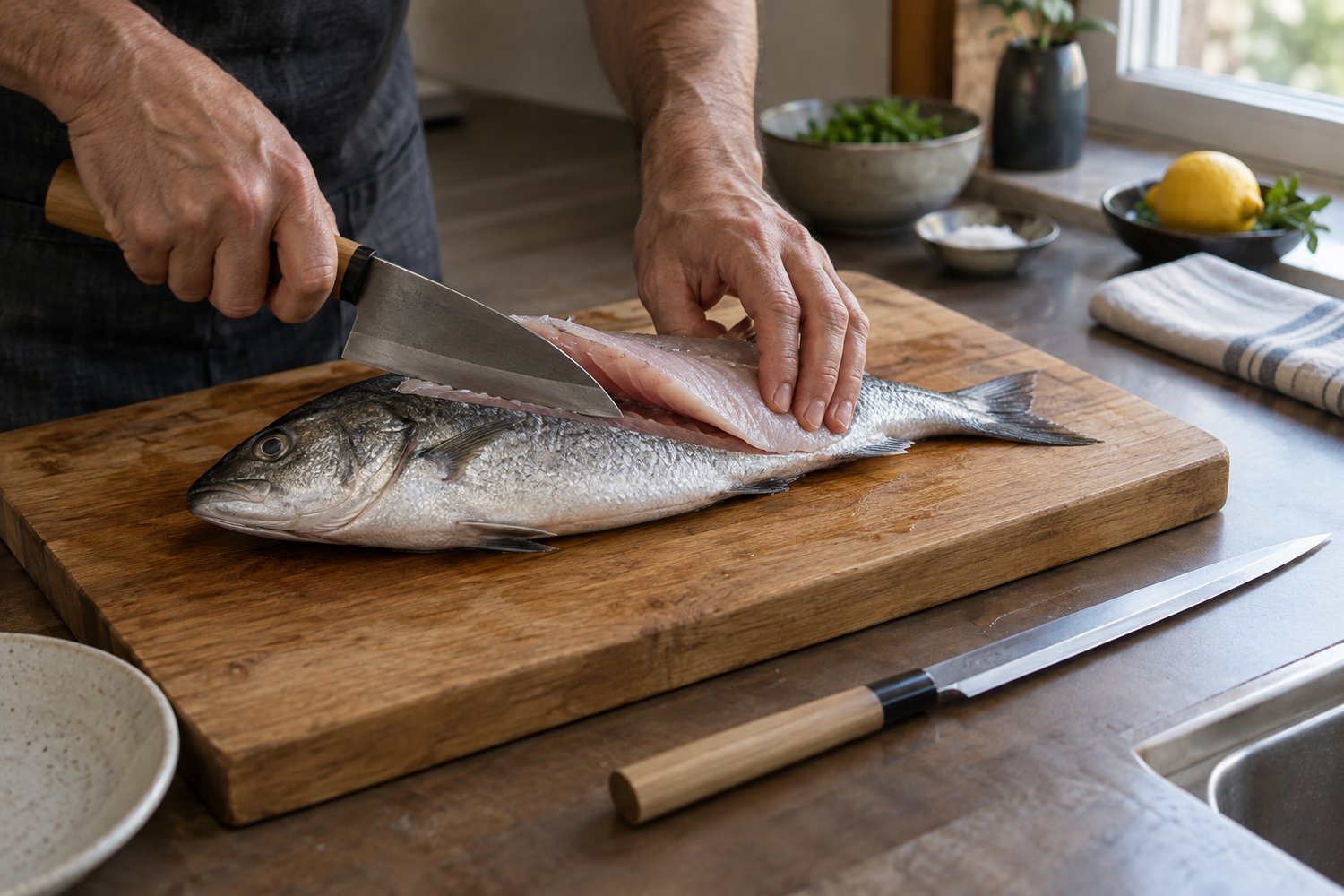
There’s a particular kind of angler: the one who doesn’t hand the fish to someone else. They come home, put the catch in the sink, and take it apart themselves. Scales, head, backbone, fillets, and if it’s good enough, thin slices eaten raw that evening.
Most of them do all of that with a Western chef’s knife, because it’s what’s in the drawer. This guide is for the person buying a gift for that angler: the two Japanese fish knives that were designed for exactly this job, three pairs at different prices from one shop that ships from Japan, and what to check before you order.
I’m a designer in Japan, not an angler and not a fish cook. I haven’t used these particular knives. What follows is the shop’s listed specifications, what the two knife types are for, and the practical questions a gift-giver needs answered. For sashimi knives in general, see the sashimi lover’s knife guide; for the angler whose fishing you know nothing about, the guide for a dad who fishes.
Why two knives, and why these two
Japanese fish cooking divides the job in two, and gives each half a knife.
The deba (出刃) breaks the fish down. It’s short, heavy and thick: the 165mm knives here weigh about 280g, well over a typical chef’s knife. MUSASHI JAPAN, a Tokyo knife retailer, describes it as “a sturdy fish knife with a solid and thick blade” that “doesn’t bend even if force is applied”, used to remove scales, handle the bones, open the back of the fish and cut the bones; the weight lets it take a head off “without damaging the blade”. That is the whole point: the work that chips a chef’s knife is what a deba is built for.
The yanagiba (柳刃) slices the result. Long and thin — the one here has a 270mm blade and weighs 180g — it draws through a boneless fillet in one pull, which is what gives sashimi its glossy, unbroken face. It is fragile at the edge and useless on bone.
An angler who has both stops using the chef’s knife for fish entirely. An angler who has only one still has a gap. That’s why this is a set.
Which one first, if you can only give one? The deba. Every fish gets broken down; not every fish gets eaten raw.
Three pairs, from one shop
All seven knives are from Hocho Knife, an online knife shop that ships from Japan; most carry the names of Sakai makers, Sakai Takayuki (Aoki Hamono) and Sakai Jikko. Specifications are from Hocho Knife’s product pages; prices are the shop’s in US dollars on 26 September 2026, before shipping, and all were listed as in stock that day. The shop sells knives individually, so each “pair” is two items in one cart.
| Pair | Deba | Yanagiba | Total |
|---|---|---|---|
| Starter | Sakai Takayuki Kasumitogi, White steel, 165mm — $127.99 | Sakai Jikko Ginsan, 210mm — $227.99 | $355.98 |
| Keeper | Sakai Jikko Ginsan, 165mm — $319.99 | Sakai Takayuki Blue No.2, 270mm — $417.99 | $737.98 |
| Left-handed | Sakai Takayuki Kasumitogi, White steel, 165mm — $274.99 | Sakai Takayuki INOX, 240mm — $255.99 | $530.98 |
The starter pair: white-steel deba 165mm + Ginsan yanagiba 210mm
The pair for the angler who has never owned a Japanese fish knife and is going to learn on these.
Deba, Sakai Takayuki Kasumitogi, 165mm: White Paper No.3 (shiroko), a high-carbon steel; single-edged, right-handed; blade 165mm, overall 315mm, 280g; magnolia handle with a reinforced plastic ring; made in Japan. White steel sharpens easily and rusts if left wet.
Yanagiba, Sakai Jikko Tanren Ginsan, 210mm: Ginsan (Silver paper No.3), a stainless steel used for traditional knives, so it forgives a wet blade better than the carbon steels on this page; blade 210mm; made in Japan. The product page lists the steel but not the weight or overall length. At 210mm it’s shorter than the 270mm home standard: it suits fillets from pan-sized fish, and it fits a smaller board.
Who it suits. Someone buying their first pair, who fillets fish of a few kilos rather than a whole salmon, and who will still dry the carbon-steel deba after every use. If they want the full 270mm length, or they’re already used to carbon steel, see the next pair.
The keeper pair: Ginsan deba 165mm + Blue No.2 yanagiba 270mm
The pair I’d give if the budget allows: a stainless deba for the wet, bloody half of the job, and a carbon yanagiba for the clean half.
Deba, Sakai Jikko Tanren Ginsan, 165mm: Ginsan (Silver paper No.3), a stainless steel; blade 165mm; made in Japan. The product page lists the steel but not the weight or overall length. The reason it’s the deba to give: gutting and filleting is the part of fish work most likely to leave a knife wet in the sink, and a stainless blade forgives that.
Yanagiba, Sakai Takayuki Aoniko Blue No.2, 270mm: the carbon yanagiba covered in detail in the sashimi guide — blade 270mm, overall 415mm, 180g, magnolia handle with a buffalo-horn ring. Blue No.2 holds its edge well; it must be wiped dry at once, which in the kitchen is easy.
Who it suits. The angler who is already serious — fillets every trip, has a whetstone, has opinions — and will notice the difference between a good knife and a great one.
If they’re already careful with carbon steel and you’d rather stay traditional, there’s also a Sakai Takayuki Tokujyo Supreme White No.2 deba, 165mm (single-edged, right-handed; overall 315mm; 280g; magnolia handle; $260.99).
The left-handed pair: deba 165mm + yanagiba 240mm
The one that solves a real problem. Single-bevel Japanese knives are ground for the right hand, and a left-handed angler usually owns none. Several left-handed versions were out of stock when checked, so this pair is what the shop had on the day.
Deba, Left-handed, Sakai Takayuki Kasumitogi, 165mm: White Paper No.3 carbon steel; single-edged for left-handed users; blade 165mm, overall 315mm, 280g; magnolia handle with a buffalo-horn ring; made in Japan.
Yanagiba, Left-handed, Sakai Takayuki INOX, 240mm: INOX stainless (AUS8A), single-edged for left-handed users; blade 240mm, overall 380mm, 140g; magnolia handle; made in Japan. 240mm is a touch shorter than the 270mm above, which suits a smaller kitchen, and the stainless blade forgives a wet knife.
Who it suits. Any left-handed angler. Check that they are, in fact, left-handed with a knife — some left-handers cut right-handed.
Before you buy: about the person
- Do they actually clean their own fish? This is the whole premise. If the catch goes to a fishmonger or a friend, give tackle instead — the guide for a dad who fishes.
- Do they eat it raw? If never, give the deba alone and skip the yanagiba.
- Which hand? Right-handed: the first two pairs. Left-handed: the third. Don’t guess.
- What size fish? Up to a few kilos: a 165mm deba. Regularly bigger: look at 180mm. A yanagiba at 270mm is the home standard; 240mm for a small kitchen.
- Will they dry the blade? Honestly. If not, the Ginsan deba is the safer gift; the carbon yanagiba is still fine because it’s used and wiped in the kitchen.
- Do they own a whetstone? Single-bevel knives are sharpened on a stone, one side at the bevel and a light pass on the flat back. Never a pull-through sharpener. If they don’t have a stone, a medium-grit one makes the gift complete.
- Cutting board. Use a soft plastic or wooden board; the deba’s weight on a glass board will damage the edge.
- Care notice. (For washing, drying and storage in more detail, see the Japanese knife care guide.) No twisting, and use the correct knife for bone, frozen or hard items (the deba is that knife for fish bone; the yanagiba is not).
- Sheath and wrapping. Sheaths are sold separately; ask the shop which fits. Hocho Knife offers gift wrapping and a message card as options at checkout.
How to buy
Okurimono Japan doesn’t sell anything. “Check Price” goes straight to the knife’s page on Hocho Knife, an online knife shop that ships from Japan. You pay Hocho Knife directly, and it handles shipping, returns and support.
What Hocho Knife’s Shipping & Returns page states, as of 26 September 2026:
- Shipping. A handling time of up to 3–5 business days after payment, then FedEx or EMS (Japan Post). Free shipping on orders over $250.
- US duties. The shop says customers may pay part of the duties at checkout, and that it advances and pays all import duties on eligible orders, so nothing more is due on delivery. Some couriers may charge the recipient a small administration fee. Check the total at checkout before you pay.
- Returns. Within 14 days of delivery, for items that are unopened and unused with all original packing; the shop pays return shipping only when the error was its own.
Prices on this page are Hocho Knife’s US dollar prices on 26 September 2026; the knives were listed as in stock, and prices and stock change. Every pair here clears the $250 free-shipping threshold. General guidance on ordering from Japan is on How to Buy; more knives are in the Kitchen Knives category.
One more thing
The angler who cleans their own fish already has the hard part: the patience, and the fish. What they’ve been missing is a knife that was made for the job instead of borrowed from a different one. Two knives, actually — but start with the deba.
Frequently asked questions
- What knife do you give someone who fillets their own fish?
- A deba. It is the thick, heavy Japanese knife made for taking a whole fish apart — scaling, removing the head, cutting through the backbone, filleting. If the person also serves their catch raw, add a yanagiba, the long slicer for sashimi. Together they are the two-knife set Japanese fish cooks use.
- What is the difference between a deba and a yanagiba?
- A deba is short, thick and heavy (about 280g for the 165mm knives here) and does the heavy work: heads, bones, filleting. A yanagiba is long and thin and does one thing: drawing clean slices from a boneless fillet. Using a yanagiba on bones will chip it; using a deba for sashimi tears the surface.
- What size deba for a home angler?
- 165mm suits most home use — fish up to a few kilos, a normal cutting board, a normal sink. 180mm is for larger fish or larger hands. Below 150mm is for small fish and detail work. Shops give blade length separately from overall length; the 165mm debas here are about 315mm overall.
- Are these knives right-handed only?
- The deba and yanagiba are single-bevel knives, ground for right-handed use. Hocho Knife lists left-handed versions of both, and this guide includes a left-handed pair. A left-handed angler cannot use a right-handed deba comfortably, so check before buying.
- Carbon steel or stainless for a fish knife?
- Carbon steel (White and Blue steels) takes a sharper edge but rusts if left wet — and fish work is wet. Stainless steels (Ginsan, or Silver No.3, and INOX) forgive a blade left on the board. For a deba that gets used on the dock or straight after a trip, this guide leans stainless; for the yanagiba, which is used in the kitchen and wiped at once, carbon is the traditional choice.
- Do the knives come as a boxed set?
- No. Hocho Knife sells each knife individually, so a 'set' here is two items in the same cart. It says it offers gift wrapping with Japanese-inspired designs and a message card as options when you order.
- Can I import Japanese kitchen knives?
- In most countries, yes — they are treated as cutlery, not weapons. Some countries require an adult signature on delivery. Outside the US, Hocho Knife says the buyer pays customs duty on receipt.
- What about shipping, duties and returns?
- Hocho Knife ships from Japan by FedEx or EMS after a handling time of up to 3–5 business days, with free shipping on orders over $250. For US orders it says it advances and pays import duties on eligible orders, so nothing more is due on delivery. Returns are accepted within 14 days of delivery for unopened, unused items with all original packing.